
Compare VPN Services
Device limits, free plans, refund windows, jurisdiction and who has actually been independently audited.
— means the registrar does not publish this figure, or we have not verified it. We leave those cells blank rather than guess. Every filled figure was read from the provider’s own pages in September 2026.
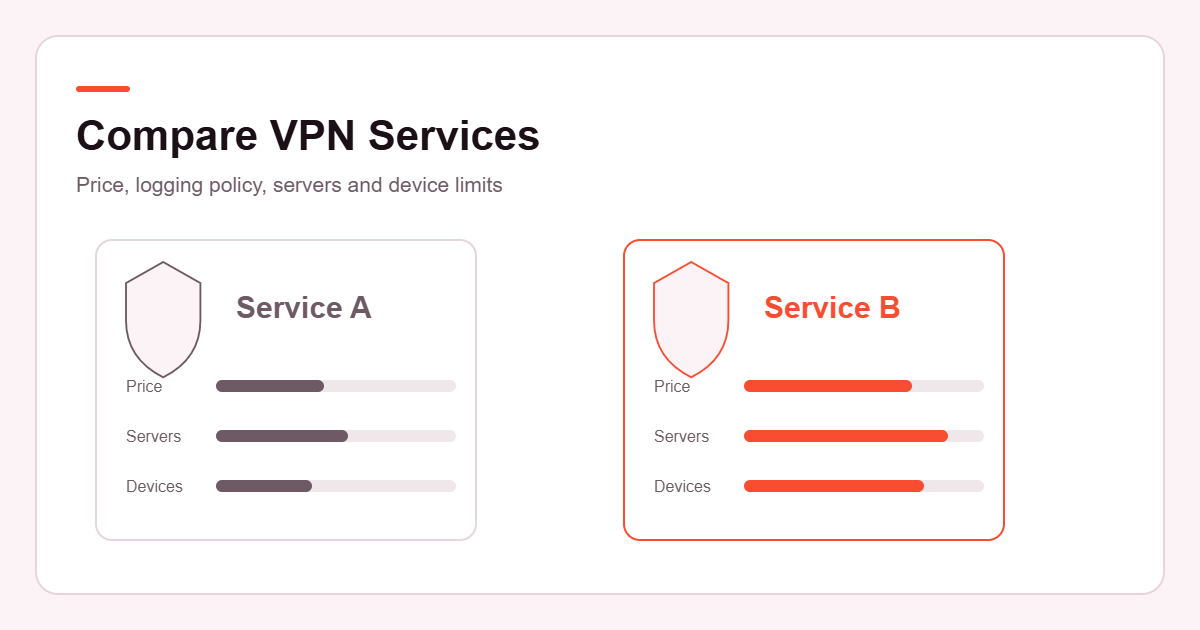
Why this table looks smaller than a phone spec sheet
VPN marketing is built on numbers that cannot be checked from the outside. Speed claims, “military-grade encryption”, how many streaming services a provider unblocks this week — none of that can be verified by reading a website, and we are not going to put it in a table as though it were fact.
What you see above is the subset that is checkable: how many devices a plan covers, whether a genuine free tier exists, the refund window, the company behind the service, and who has published an independent audit. Those rows come straight from each provider’s own pages.
The rows worth reading first
Independent audit. Every VPN says it keeps no logs. The question is whether anyone outside the company has checked. ExpressVPN names KPMG and PwC. Proton VPN’s apps are open source and independently audited. NordVPN says it audits regularly but does not name the firm on its About page. The rest do not mention an audit on the pages we checked — which is not proof of anything, only an absence.
Jurisdiction. Where a company is registered decides which government can compel it. Proton is in Switzerland; Surfshark’s legal entity is in the Netherlands; NordVPN’s parent, Nord Security, is headquartered in Lithuania. Several providers do not state it plainly on their main pages, and those cells are blank.
Free plan. Only three here have one, and they are very different. Proton VPN gives one device with no data or speed limit. Windscribe gives 10 GB a month once you confirm an email. Hotspot Shield’s free tier is ad-supported. “Free VPN” elsewhere usually means a trial.
Why there is no price column
We deliberately left one out. VPN pricing is almost entirely promotional — the advertised figure depends on the length of the term, whether a sale is running, and which country you are browsing from, and it changes month to month. A price table here would be wrong within weeks, and a wrong price in a tool people trust is worse than no price at all.
What we do show is the pricing model, where a provider publishes something structural rather than promotional. Mullvad charges a flat €5 a month whatever term you pick and says it has not changed that rate since 2009. Windscribe publishes a monthly rate, a yearly rate and a build-your-own plan from $3. Those are facts about how the company prices, not this week’s banner.
How to compare VPN services when most of the claims are unverifiable
The hardest part of choosing a VPN is that the two things people care about most — raw speed, and whether the provider really keeps no logs — are the two things you cannot confirm from the outside. Everything below is a way of working around that, so you can compare VPN services on evidence rather than on adjectives.
- Read the audit, not the badge. “Independently audited” can mean a full examination of production servers, or a narrow review of one browser extension. Check who carried it out, what was in scope, and the date. Compare VPN services on the scope of an audit, not on whether the word appears. An audit from four years ago describes a company that may have changed a great deal since.
- Know who owns the provider. Several well-known VPN brands sit under the same parent companies. That is not automatically a problem, but it does mean that when you compare VPN services, a shortlist of three can quietly be a shortlist of one.
- Jurisdiction matters less than the marketing suggests, but it is not nothing. Where a provider is registered determines what it can be compelled to hand over. That only bites if there is something to hand over, which is why the jurisdiction row and the audit row should be read together.
- A free tier is not a free trial. A free tier runs indefinitely with limits on data or locations. A trial expires. Compare VPN services on which of the two is actually on offer. A money-back window is neither — you pay first and ask for it back, and the terms often differ between card payments and app-store purchases.
- Devices covered, not devices installed. Most limits count simultaneous connections, so you can install the app everywhere and only run it on so many at once. A router usually counts as one connection however many devices sit behind it, which is worth remembering when you compare VPN services on household coverage.
What a VPN will not do for you
A VPN encrypts the traffic between your device and the provider’s server, and hides your IP address from the sites you visit. It does not make you anonymous. Signing in to an account identifies you regardless of the tunnel, browser fingerprinting works exactly as before, and the provider itself is now in the position your network operator was in — which is the whole reason the no-logs question matters. The Electronic Frontier Foundation’s guide to choosing a VPN is a good non-commercial primer on where the real risks sit.
It also will not reliably unblock any particular streaming catalogue. Providers and platforms are in a permanent back-and-forth, so a service that works this month may not next month. If that is your only reason for subscribing, buy the shortest term you can and test it inside the refund window.
The short version: compare VPN services on the handful of things a provider has committed to in public — ownership, jurisdiction, audit scope and date, device limits and refund terms — and treat the rest as marketing until somebody outside the company has checked it.
For the full write-up on each provider, read Best VPN Services in 2026: 10 VPNs Compared. You can also compare domain registrars with the same tool.
Check before you buy. Device limits and refund windows change, and so do server counts. Confirm on the provider’s own site.
Other free tools