
Domain Renewal Cost Calculator
Set how long you will actually keep a domain and see what each registrar really costs — renewals included.
Costs below are for a standard .com, in US dollars, using each registrar’s own published pricing. Total = first year + renewals.
Compare a price you have been quoted
Enter any registrar’s first-year and renewal price to see where it lands.
Three registrars are deliberately not in the list above, because they do not publish a fixed figure we could calculate honestly:
Cloudflare charges the registry and ICANN fee with no markup, at registration and at renewal — so it is the cheapest option here, but the exact number moves with the registry. Note that domains registered there must use Cloudflare nameservers.
GoDaddy advertises first-year promotions that are new-customer only, vary by country and sometimes require a multi-year purchase. WordPress.com gives the first year free with any annual paid plan, then bills at standard rates it does not publish as a flat figure.
Why the first-year price tells you almost nothing
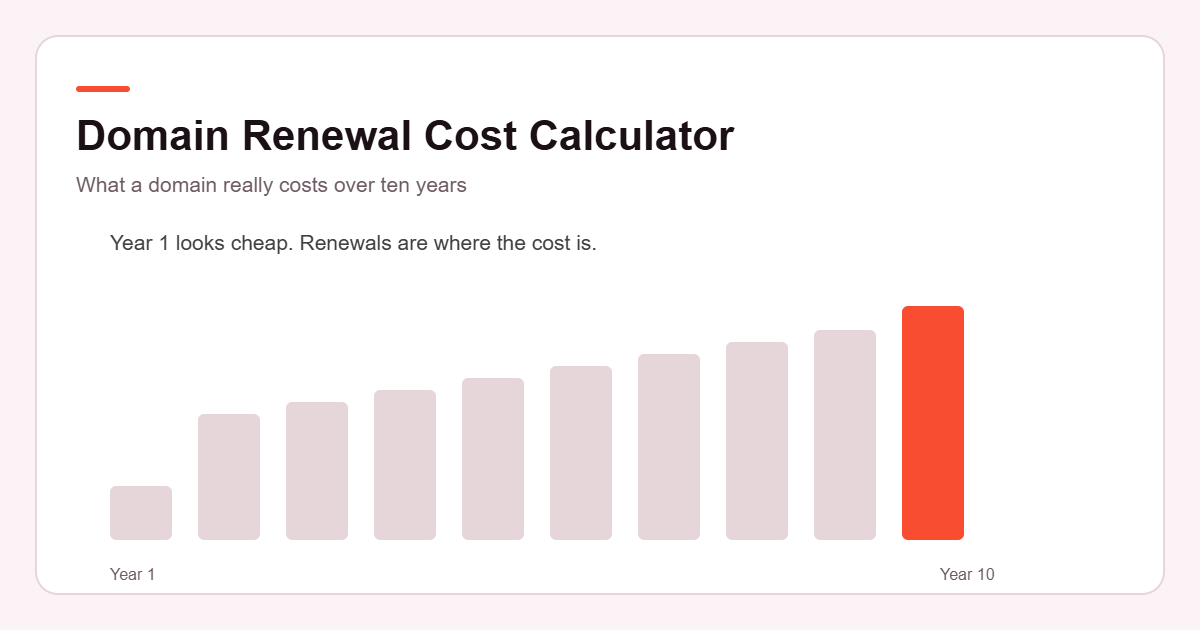
A domain is not a one-time purchase. It is a subscription you will most likely hold for as long as the site exists. Registrars know this, which is why the number on the banner is a customer-acquisition cost and the number you actually live with is the renewal.
Set the slider to one year and the cheapest options look very different from the five-year view. That gap is the entire point of this tool. A registrar charging $5.10 for the first year and $20 after it will cost you more by year three than one charging a flat $11.08 forever.
What to check before you buy
Find the renewal price first. Before anything else, locate the renewal figure for the exact extension you want. If you cannot find it on the registrar’s own site in under a minute, treat that as information about the registrar.
Add the cost of privacy if it is not free. WHOIS privacy keeps your name, address, email and phone out of a public directory. It costs a registrar almost nothing, and most of the registrars above include it at no charge. If yours charges roughly ten dollars a year for it, add that to every row before comparing.
Check the extension, not just the .com. Renewal prices vary enormously by TLD. Hover lists .com at $18.99 and .io at $74.99. A cheap first year on an unusual extension can become an expensive habit.
Remember the 60-day transfer lock. ICANN rules generally prevent a newly registered or recently transferred domain from moving for 60 days. Registering somewhere cheap intending to move it straight away does not work.
How to use the domain renewal cost calculator
Pick the extension you are buying, then the registrars you are weighing up, and the domain renewal cost calculator adds the first-year promotional price to the standard renewal for every year after that. The slider sets how far ahead to look, from one year to ten.
The total at the bottom is what the name will have cost you by the end of that period — the number that matters if you intend to keep it, and the one a domain renewal cost calculator is really for.
Two habits make it more useful. Run the domain renewal cost calculator over ten years rather than five when the domain is for something you expect to still be running, because the gap between a cheap first year and a standard renewal compounds. And re-run it at renewal time, not only at purchase: registrars adjust their standard rates, so the cheapest option in 2026 is not automatically the cheapest in 2029.
Where these numbers come from
Every figure in this calculator was read directly from the registrar’s own published pricing page in September 2026, and each is labelled with the terms it assumes. We did not use third-party roundups, affiliate dashboards or cached data.
Domain pricing moves. Registries raise wholesale fees, promotions start and end, and many registrars display prices in local currency, so the figure you see at checkout may differ from the US price shown here. Confirm the current number on the registrar’s own site before you buy. If you spot a figure that has changed, we would rather hear about it than leave it wrong — there is a contact link in the footer.
Want to see two or three registrars side by side on features rather than cost — what comes free, and whether you keep control of your own DNS? Use the domain registrar comparison tool.
For the full comparison — what each registrar includes free, where the pricing traps are, and who each one actually suits — read Best Domain Registrars in 2026: 10 Options Compared.
Sources: Porkbun, Dynadot, Namecheap, NameSilo, Hover, Squarespace, IONOS, Cloudflare.
Reference: Registrars must warn you before a domain lapses — see ICANN’s Expired Registration Recovery Policy.
Other free tools