
Compare Domain Registrars
Put any two or three registrars side by side — price, what comes free, and whether you keep control of your own DNS.
— means the registrar does not publish this figure, or we have not verified it. We leave those cells blank rather than guess. Every filled figure was read from the registrar’s own pages in September 2026.
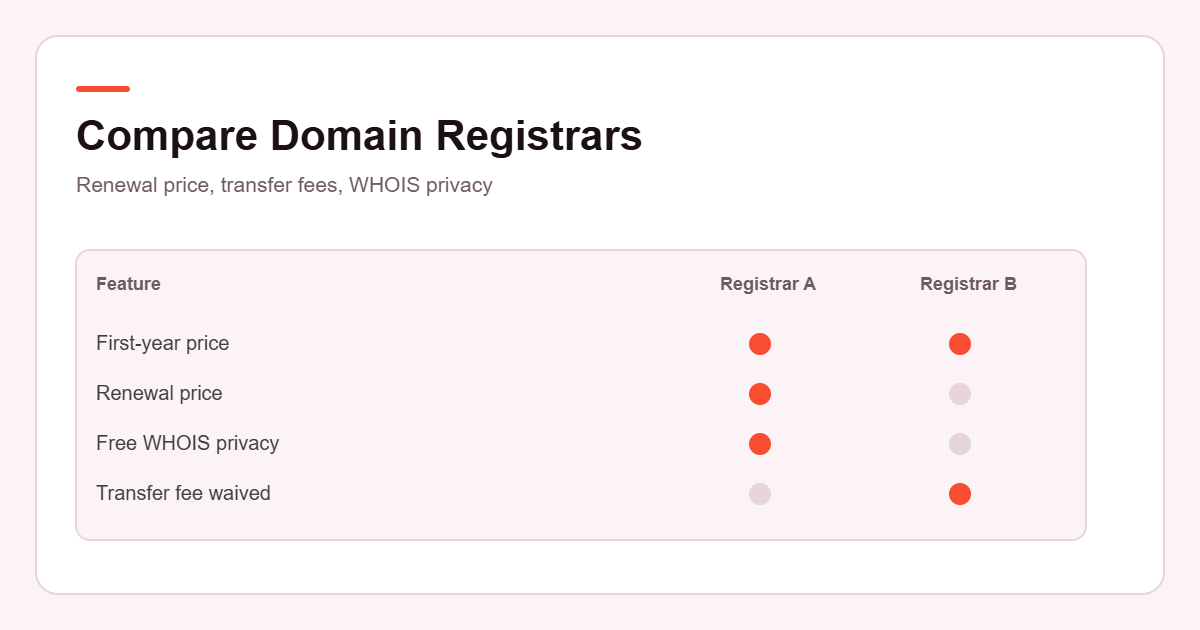
The three rows that decide most of it
Renewal price, not first year. A domain is a subscription you will hold for years. IONOS costs $5.10 for the first year and $20 after it; Porkbun costs $11.08 every single year. By year three the “expensive” one is cheaper. If you want that maths done for your own timeline, use the domain renewal cost calculator.
WHOIS privacy. Without it, the name, address, email and phone you register with can sit in a public directory. It costs a registrar almost nothing, and eight of the ten here include it free. Paying separately for it in 2026 is a reason to choose someone else.
Nameserver freedom. This is the one row people miss. Cloudflare Registrar is the cheapest option on this page, but its own documentation states that domains registered there must use Cloudflare nameservers and cannot be pointed at another DNS provider. For most people that is fine. If you need your DNS elsewhere, it rules Cloudflare out entirely — no matter what the price says.
What this tool does not do
It does not rank registrars for you. The editorial score reflects how well each one serves the job we recommend it for, not which is “best” in the abstract — a registrar scoring 7.5 is a narrower fit, not bad software.
It also does not fill in blanks. Where a registrar does not publish a figure, or we could not verify it against a first-party source, the cell stays empty. A half-filled honest table is more useful than a full one built on guesses.
Prices move. Registries raise wholesale fees, promotions start and end, and several of these registrars display prices in local currency, so your checkout figure may differ from the US price shown here. Confirm on the registrar’s own site before you buy.
How to compare domain registrars without getting caught out
Almost every complaint about a registrar comes down to something that was true at checkout and stopped being true a year later. The table above covers the first year, which is where most people compare domain registrars and stop. These are the six things worth checking on the registrar’s own pricing page when you compare domain registrars, before you hand over a card.
- The renewal price, not the first-year price. A $1 .com is a discount on year one. Year two is the number you will pay for as long as you own the name, and it is often ten to fifteen times the headline. Compare domain registrars on that number and the order usually changes.
- The ICANN fee. Every gTLD registration carries a mandatory ICANN fee, currently $0.18 per domain per year. Some registrars fold it into the advertised price and others add it at checkout. It is small, but it tells you how that registrar likes to quote.
- The transfer-out fee. ICANN does not permit a charge purely for leaving, but some registrars still bill for related steps or make the authorisation code slow to obtain. Look for a plain statement that transfers out are free.
- Pre-ticked add-ons. Site builders, email trials, SSL certificates and “protection” upsells are often selected by default. Read the basket line by line before paying.
- Whether WHOIS privacy is permanent. “Free privacy” sometimes means free for twelve months. Check that it is included for the life of the domain rather than the length of the intro offer.
- Premium and restricted extensions. Endings such as .io, .ai and .dev price very differently from .com, and a registrar that is cheap on .com is not automatically cheap on those. Compare domain registrars on the extension you actually want, not just on .com.
You are not locked in
If you compare domain registrars again at renewal and the quote looks worse than you expected, moving is usually straightforward. A domain can be transferred to another registrar 60 days after it was first registered, 60 days after a previous transfer, and at many registrars 60 days after a change of registrant details. Outside those windows you unlock the domain, request the authorisation code from your current registrar, and pay the new one for a year — which adds to the existing expiry date rather than resetting it.
Two habits make that easier later: keep the registrant email address current, because that is where transfer approvals are sent, and keep the domain separate from your hosting where you can, so that changing one does not force a change of the other.
The habit worth keeping is simple: compare domain registrars again every time a renewal notice arrives, not only on the day you buy. Pricing changes quietly, and the gap across ten years of renewals is usually far larger than the gap on day one.
For the full write-up on each one — where the pricing traps are and who each registrar actually suits — read Best Domain Registrars in 2026: 10 Options Compared.
Other free tools
Reference: The transfer rules every accredited registrar must follow are set out in the ICANN Transfer Policy.