
Freelance Hourly Rate Calculator
Work out the hourly rate you need to charge after tax, costs and unpaid time — and convert any salary to hourly, daily, monthly or yearly pay.
- 2 calculatorsfreelance rate + salary
- Maths shownevery step explained
- 100% freeno sign-up

Work out the hourly rate you need to charge to earn your target income after tax, expenses and unpaid time. The numbers below are examples — change them to match your situation.
Convert pay between hourly, daily, weekly, monthly and yearly. By default this uses 40 hours a week for 52 weeks (2,080 hours a year).
Results are estimates for planning, not tax or financial advice. Tax rules depend on where you live — check your rate with your tax office or an accountant.
How it works
Find a rate you can live on in three quick steps.
- Set your target
The income you want to keep, your costs and your tax rate.
- Add your real hours
Weeks off and how much of your time is billable.
- Get your rate
Hourly, daily and project prices, with the maths shown.
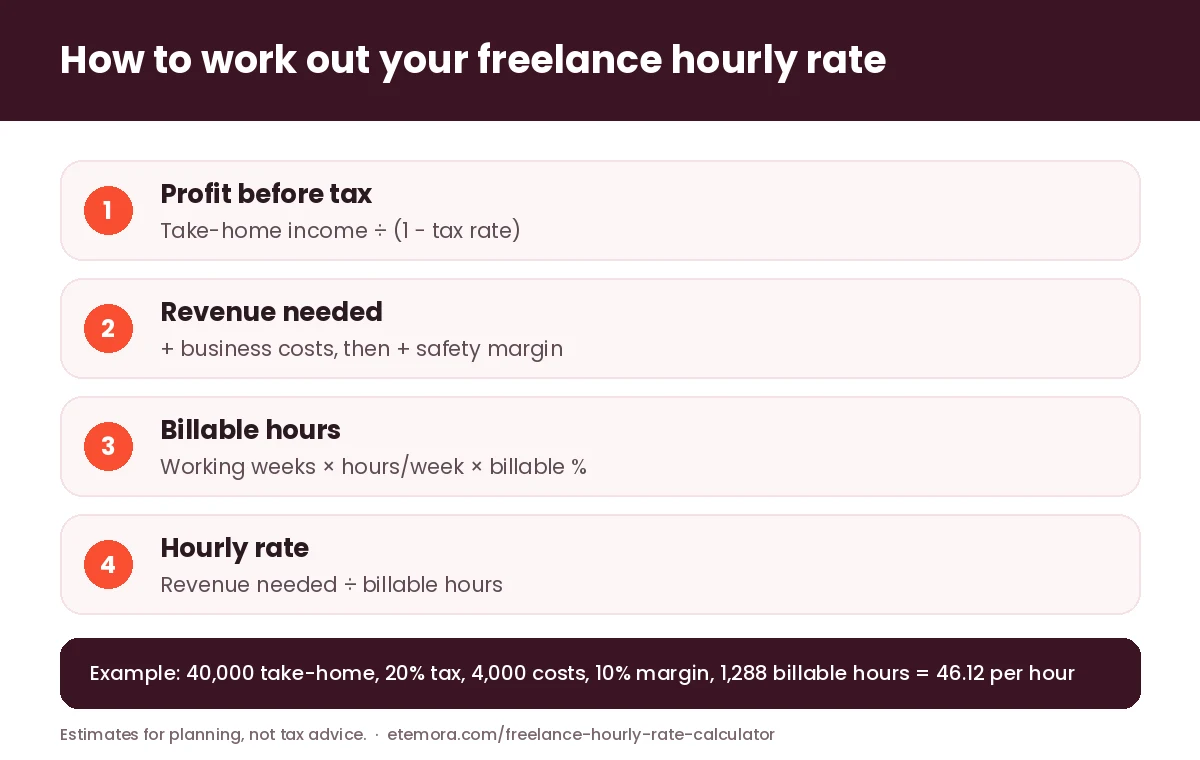
How to calculate your freelance hourly rate
A common mistake is to take a job salary, divide it by 2,080 hours and charge that. As a freelancer you pay your own tax and business costs, you are not paid for holidays or sick days, and a good part of every week goes on work nobody pays for directly — finding clients, writing proposals, admin and invoicing. This freelance hourly rate calculator builds those in:
- Profit before tax = the income you want to keep ÷ (1 − your tax rate).
- Revenue needed = profit before tax + business costs, plus a safety margin for quiet months and late payers.
- Billable hours = working weeks × hours per week × the share of that time you can bill.
- Hourly rate = revenue needed ÷ billable hours.
The result is the minimum rate that meets your target. What you can actually charge also depends on your skills, your market and what clients expect to pay, so look at what others with similar experience charge and treat this number as your floor, not your ceiling.
Choosing realistic inputs
Tax rate: use your own estimate of income tax plus any self-employment or social-security charges where you live. If you are unsure, ask an accountant or check your tax office’s website — the calculator does not know your country’s rules. Business costs: add up software, hardware, internet, insurance, co-working, platform and payment fees, and accounting.
Weeks off: count holidays, public holidays, sick days and time for training. Billable share: if you spend a day a week on admin and finding work, only about 80% of a 40-hour week is billable; many new freelancers spend more. The example values in the freelance hourly rate calculator are starting points — change them to match your week.
Salary to hourly: how the converter works
The salary to hourly converter uses the common full-time convention of 40 hours a week for 52 weeks, which is 2,080 paid hours a year. Hourly pay = yearly pay ÷ 2,080, weekly = yearly ÷ 52 and monthly = yearly ÷ 12. You can change the hours, days and paid weeks. Different employers use different divisors — for example, the US Office of Personnel Management divides annual basic pay by 2,087 hours to get an hourly rate for federal employees — so small differences from your payslip are normal.
All converter results are gross, before tax and deductions.
From hourly rate to quotes and invoices
Many clients prefer a fixed price. Estimate the hours a project will take, add a buffer for revisions, and enter the hours in Hours for a project quote to get a price at your rate. When the work is done, our free invoice generator creates a PDF invoice with tax and your logo.
If you sell through platforms, remember their fees come out of what you earn — our Upwork vs Fiverr comparison explains how each one charges. New to client work? Start with how to start freelancing, and see how to make money online for other options.
Is the freelance hourly rate calculator private?
Yes. Every calculation runs in your browser. The numbers you enter are not sent to our server or stored anywhere.
Freelance hourly rate calculator: frequently asked questions
How do I calculate my freelance hourly rate?
Work out the revenue you need — your target take-home income grossed up for tax, plus business costs and a safety margin — then divide it by the hours you can actually bill in a year after time off and non-billable work. The freelance hourly rate calculator above does these steps for you.
Why is my freelance rate so much higher than my old hourly wage?
Because a freelance rate has to cover things an employer used to pay for or that you are no longer paid for: tax and social charges, equipment and software, holidays, sick days, and the hours spent finding clients and doing admin.
How many working hours are in a year?
A common full-time figure is 2,080 hours (40 hours × 52 weeks). Freelancers bill far fewer, because of time off and unpaid work; the calculator shows your own billable hours.
How do I convert a yearly salary to an hourly rate?
Divide the yearly salary by the number of paid hours in a year — usually 2,080 for 40 hours a week. For example, 50,000 a year ÷ 2,080 = about 24.04 an hour before tax.
What is a day rate?
A day rate is your hourly rate multiplied by the hours in a working day. The calculator shows an 8-hour day rate; some clients expect 7 or 7.5 hours, so check before you quote.
Does this include tax advice?
No. The tax rate is your own estimate. Tax rules depend on your country and situation, so check with your tax office or an accountant.
More free tools: see all Etemora tools.
Other free tools
Guides related to this tool
 FreelancingHow to Start Freelancing: 7 Proven Steps in 2026
 FreelancingUpwork vs Fiverr: Which Platform Is Right for Freelancers?
 FreelancingHow to Make Money Online in 2026: 15 Legit Ways & Platforms