
Best Domain Registrars in 2026:
10 Options Compared
By M. Zaid
- September 12, 2026
- 33 min read

Affiliate Disclosure: Some links on this page may be affiliate links. If you buy through them, Etemora may earn a commission at no additional cost to you. Affiliate relationships never determine our rankings. Learn more →
Almost every “cheap domain” headline you have ever seen was about one year. The first one. After that the price you actually live with is the renewal price, and at some registrars that number is nearly twenty times the one that got you in the door.
That single fact reorganises this entire comparison. A domain is not a product you buy once — it is a subscription you will probably hold for a decade, and the registrar charging $5 today may cost you more by year three than the one charging $11 flat forever.
So the ranking below is built on what a domain costs over five years, what the registrar gives you without charging extra, and how honestly it shows you its own prices. Every figure was read off the registrar’s own published pricing page in September 2026. Where a registrar does not publish a flat number, we say so instead of inventing one.
Read this before the rankings
This is a research-based comparison. Etemora has not held an account at all ten of these registrars, and we do not claim to have transferred a domain through every one of them. What we can stand behind is the pricing: each figure below was read off the registrar’s own published price table in September 2026 and is labelled with the terms it assumes. Domain pricing moves — registries raise wholesale fees, promotions start and end, and prices are shown in local currency in many countries — so confirm the current number on the registrar’s own site before you buy. Figures here are US pricing unless stated otherwise. That is the whole basis on which we call these the best domain registrars: published prices you can check for yourself, not scores we invented.
- The 10 Best Domain Registrars at a Glance
- 1. Porkbun — Best Overall
- 2. Cloudflare — Cheapest Long-Term
- 3. Namecheap — Best All-Rounder
- 4. Dynadot — Best Low Flat Price
- 5. NameSilo — Best for Portfolios
- 6. Squarespace — Best Interface
- 7. Hover — Best Upsell-Free Experience
- 8. GoDaddy — Widest Choice and Support
- 9. IONOS — Cheapest First Year
- 10. WordPress.com — Best Bundled Domain
- The Renewal Trap: Five-Year Cost Compared
- What Should Be Free (And Usually Is Not)
- How to Choose a Domain Registrar
- Six Expensive Mistakes to Avoid
- Frequently Asked Questions
- How We Compared These Registrars
Quick picks
- Best overall: Porkbun
- Cheapest over ten years: Cloudflare
- Best all-rounder: Namecheap
- Best low flat price: Dynadot
- Best for large portfolios: NameSilo
- Best interface: Squarespace
- Fewest upsells: Hover
- Most extensions: GoDaddy
- Cheapest first year: IONOS
- Best bundled with a site: WordPress.com
The 10 Best Domain Registrars at a Glance
The prices below are for a standard .com, because it is the extension most people are actually choosing between and the one every registrar on this list sells. Figures are the registrar’s own published numbers in September 2026.
| Registrar | Best for | .com price | Privacy included |
|---|---|---|---|
| Porkbun | Flat pricing with everything included | $11.08 register and renew | Yes, free |
| Cloudflare | Lowest possible long-term cost | Registry cost, no markup | Yes, free redaction |
| Namecheap | Balance of price, tools and support | $11.28 first year, $18.48 renewal | Yes, free for life |
| Dynadot | Low listed price, strong control panel | $10.88 listed | Yes, free |
| NameSilo | Holding many domains cheaply | $17.29, falling with volume | Yes, free forever |
| Squarespace | Clean, all-inclusive pricing | $20 flat, all fees included | Yes, free |
| Hover | No upsells, identical renew price | $18.99 register, renew and transfer | Yes, on supported domains |
| GoDaddy | Extension choice and 24/7 support | Promotional first year, then standard rate | Yes, free |
| IONOS | Lowest entry price | $5.10 first year, $20 regular | Not stated on the domain page |
| WordPress.com | A domain bundled with a website | Free first year with an annual plan | Yes, with eligible plans |
Two patterns jump out. First, the honest registrars — Porkbun, Cloudflare, Hover, Dynadot, Squarespace — publish one number and charge it again at renewal. Second, the registrars with the most eye-catching first-year prices are the ones where the first year tells you the least about what you will pay.
1. Porkbun — Best Domain Registrar Overall
Best for: anyone who wants one low price that does not change at renewal, with the extras other registrars charge for included by default.
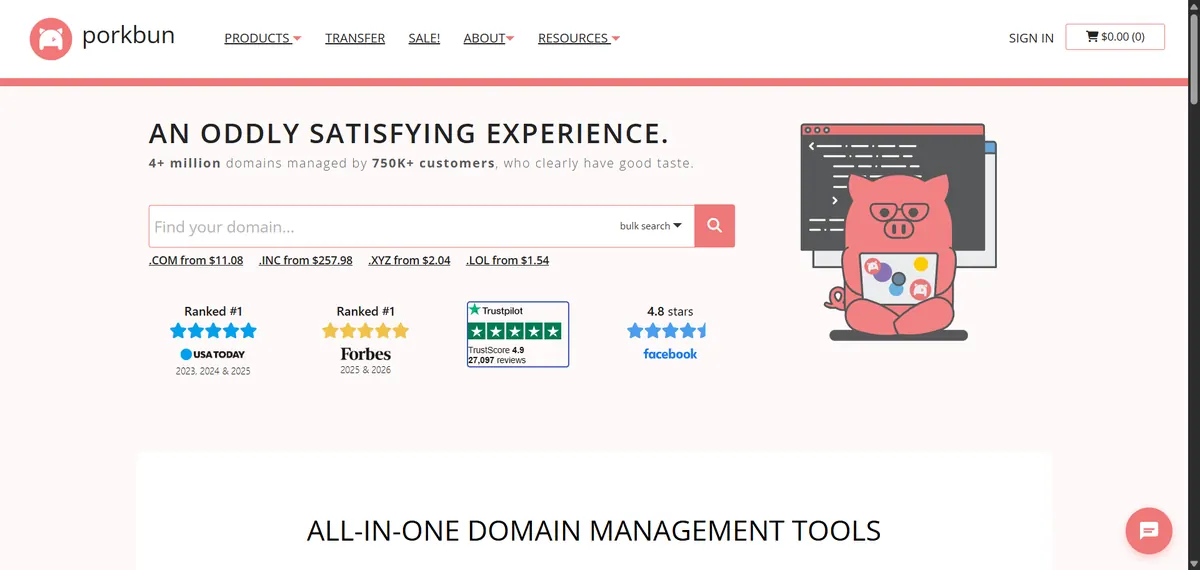
Porkbun does the simple thing that is somehow rare: it publishes a price, and that price is the same when you renew. A .com is $11.08 to register and $11.08 to renew, and the pricing page states that all prices include ICANN and any other fees — so the number you read is the number at checkout, not a starting point that grows through the cart.
What comes attached matters just as much. WHOIS privacy, SSL certificates and URL forwarding are free, not upsells. At a registrar that charges roughly $10 a year for privacy, that single line item is almost as large as Porkbun’s entire domain fee.
The trade-off is scale. Porkbun is a smaller operation than GoDaddy or Namecheap, support is email-based rather than 24/7 phone, and the brand is informal in a way that some businesses will find odd on an invoice. None of that affects the domain, which is the thing you are buying.
| Best for | Flat, honest pricing with extras included |
| .com register | $11.08 |
| .com renewal | $11.08 — the same price |
| Included free | WHOIS privacy, SSL certificate, URL forwarding |
| Fees | All prices stated to include ICANN and other fees |
Pros
- Register and renew at the same price — no first-year bait
- Free WHOIS privacy, SSL and URL forwarding
- Prices stated to include ICANN and other fees
- Clean, genuinely usable control panel
Cons
- Smaller company than the household names
- Support is not 24/7 phone support
- Informal branding will not suit every business
- Fewer bundled business services than GoDaddy or Squarespace
2. Cloudflare — Cheapest Domain Registrar Long-Term
Best for: people who already use Cloudflare, or anyone who wants the mathematically lowest possible price and does not need to choose their own nameservers.
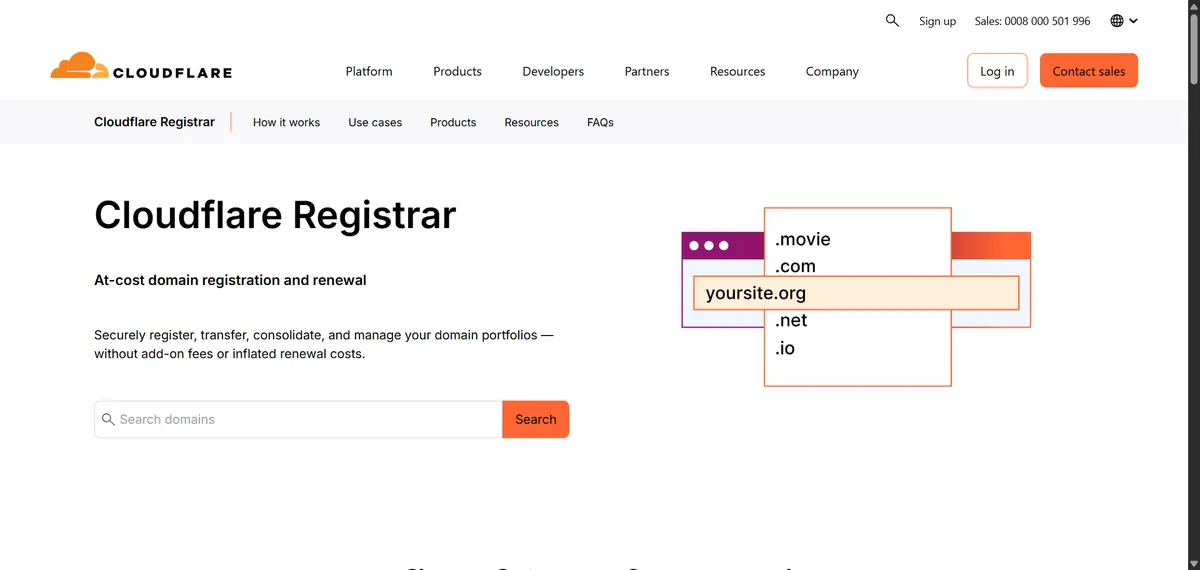
Cloudflare Registrar is not trying to make money on domains. In its own words, it “does not mark up domain prices at all” — you pay only what the registry and ICANN charge, at registration and at renewal. No other registrar on this list can make that claim, because every other registrar on this list is a business that profits from domains.
It covers over 390 top-level domains, and free WHOIS redaction, DNS, CDN and SSL come with it. For a ten-year hold on a single .com, nothing here will cost you less.
There is one condition, and it is significant enough that it decides the matter for some people. Cloudflare’s own documentation states that all domains registered there use Cloudflare nameservers, and that you will not be able to change to another DNS provider’s nameservers while the domain sits with Cloudflare Registrar. If you need your DNS somewhere else, this registrar is not an option — that is a design decision, not a bug.
| Best for | The lowest achievable long-term domain cost |
| Pricing model | Registry and ICANN fee only, no markup, at registration and renewal |
| Extensions | Over 390 TLDs |
| Included free | WHOIS redaction, DNS, CDN, SSL |
| Requirement | Domains must use Cloudflare nameservers; third-party nameservers are not supported |
Pros
- At-cost pricing — no markup on registration or renewal
- Over 390 extensions supported
- Free WHOIS redaction, DNS, CDN and SSL
- Renewal price tracks the registry, not a marketing calendar
Cons
- You cannot use a third-party DNS provider’s nameservers
- Requires a Cloudflare account and some comfort with its dashboard
- Not every extension is available
- No hand-holding domain support of the GoDaddy variety
3. Namecheap — Best All-Rounder
Best for: people who want a low first-year price alongside real support, hosting, email and a mature control panel.
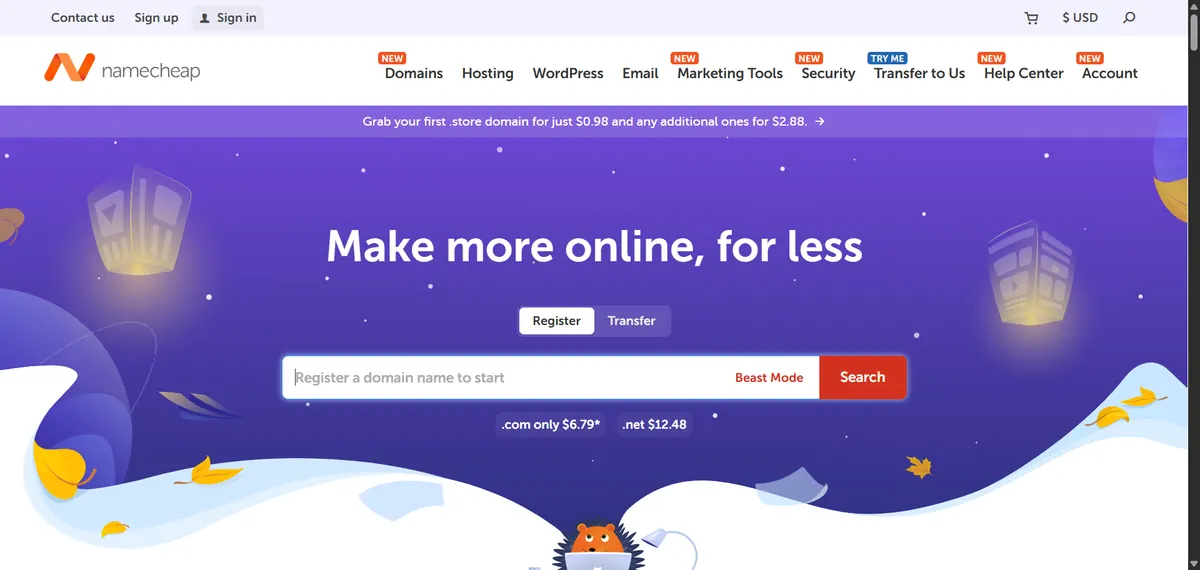
Namecheap is the registrar most people end up at, and mostly for good reason. A .com lists at $14.98, currently sells at $11.28 for the first year, and drops to $6.79 for new customers. Free lifetime domain privacy is included, along with BasicDNS and DNSSEC — Namecheap was pushing free WHOIS privacy years before it became the industry norm.
Then the renewal arrives at $18.48. That is not a scandal — it is published on the same page as the promotional price — but it is the number that matters, and it is roughly 2.7 times the new-customer rate. Over five years a Namecheap .com costs meaningfully more than a Porkbun one, even though Namecheap looks cheaper on day one.
What you get for the difference is breadth: hosting, private email, SSL certificates, a VPN and 24/7 support all under one login. If you want one vendor rather than four, that has real value.
| Best for | One account for domains, hosting, email and SSL |
| .com list price | $14.98 |
| .com first year | $11.28 with the current 25% discount; $6.79 for new customers |
| .com renewal | $18.48 |
| .com transfer | $11.48 |
| Included free | Lifetime domain privacy, BasicDNS, DNSSEC |
Pros
- Free lifetime domain privacy on every domain
- Genuinely cheap first year, especially for new customers
- Hosting, email, SSL and VPN under one account
- 24/7 support and a well-built control panel
Cons
- $18.48 renewal is well above the first-year price
- Checkout offers a lot of add-ons
- ICANN fee is added on top of the displayed price
- More expensive than Porkbun or Cloudflare across a long hold
4. Dynadot — Best Low Flat Price
Best for: people who want a low published price and a control panel built for managing domains rather than selling you hosting.
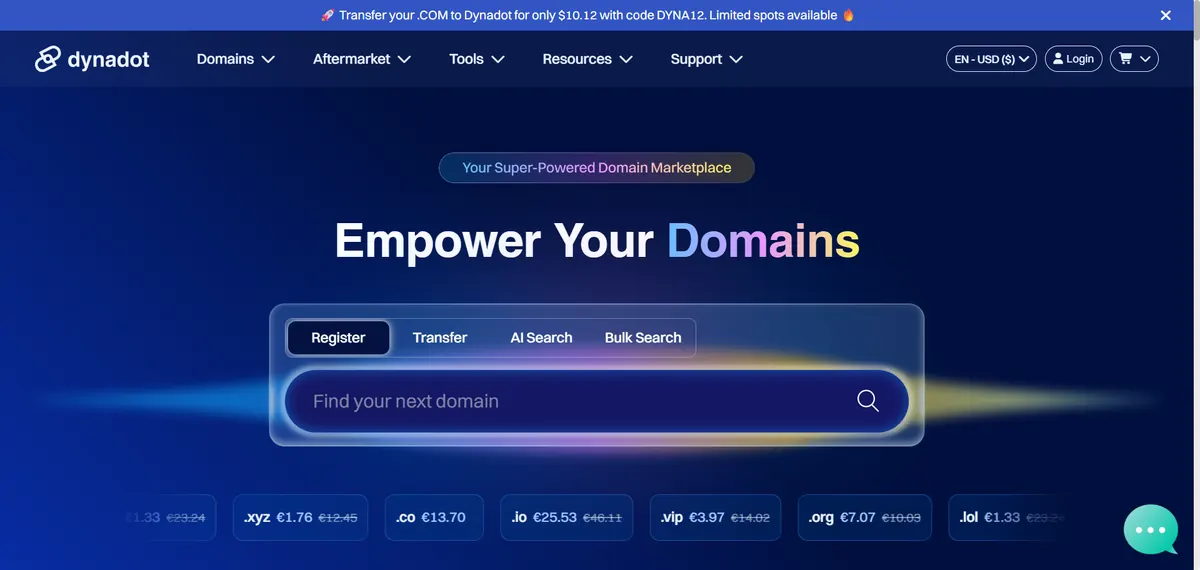
Dynadot lists a .com at $10.88 on its public price table — the lowest headline figure of any full-service registrar here — and bundles free domain privacy, a free custom email address and a free website builder with every domain.
Its real strength is the tooling. Dynadot is built for people who own more than one domain: bulk search, bulk management, a marketplace, auctions and an API are all first-class rather than bolted on. Spending tiers at $500 and $5,000 unlock bulk pricing and higher API limits, which is aimed squarely at domain investors.
Two honest caveats. Dynadot’s price table splits into register, renew and transfer columns and the figures can differ by extension, so check the renewal column for the specific TLD you want rather than assuming the headline price holds. And the site notes that pricing may vary with currency exchange rates, which is a real factor outside the US.
| Best for | Low flat pricing and multi-domain management |
| .com price | $10.88 as listed on the public price table |
| Included free | Domain privacy, custom email address, website builder |
| Bulk tiers | Bulk at $500 spend, Superbulk at $5,000 spend |
| Note | Prices may vary with currency exchange rates |
Pros
- Lowest listed .com price of the full-service registrars here
- Free domain privacy, email address and website builder
- Excellent bulk tools, API and marketplace
- Public price table with no coupon hunting
Cons
- Renewal prices vary by extension — check before assuming
- Pricing shifts with exchange rates outside the US
- Interface is dense if you only own one domain
- Smaller support footprint than the big names
5. NameSilo — Best for Large Portfolios
Best for: people holding dozens or hundreds of domains who want the price to fall as the portfolio grows.
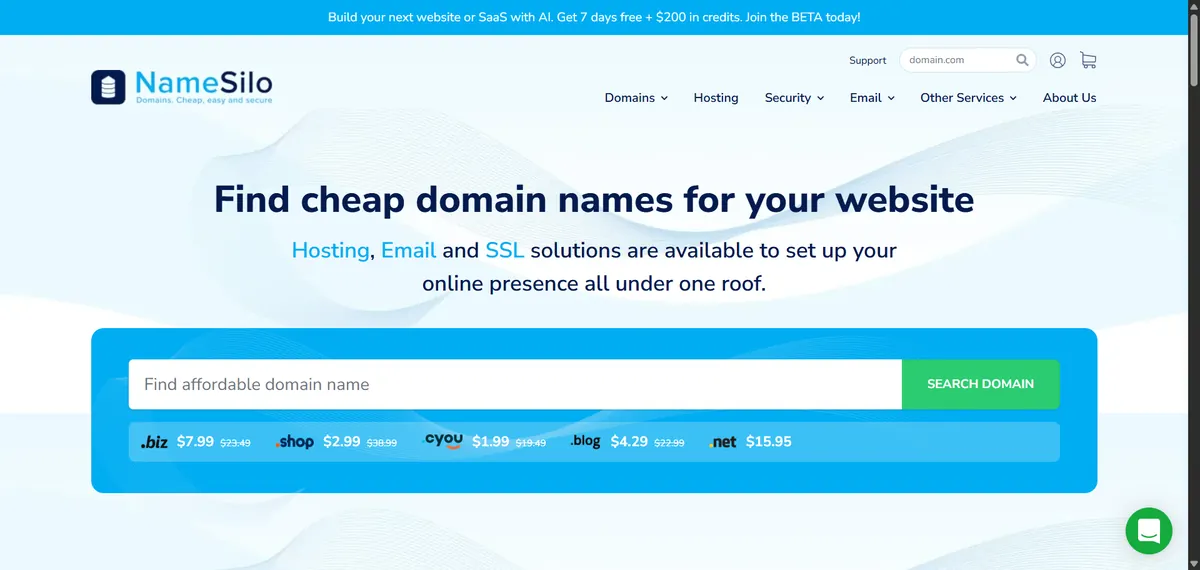
NameSilo’s pitch is that everything other registrars sell as an add-on is free: WHOIS privacy forever, email forwarding, DNS management, domain forwarding, custom WHOIS records, parking where you keep 100% of the revenue, and its Domain Defender protection — all at no charge on every registration.
The .com price for a normal account is $17.29, which is not cheap on its own. The point is what happens next: NameSilo’s discount tiers step the price down as your domain count rises, reaching the $10.80–$11.05 range at the top tiers. For one domain that is irrelevant. For a hundred, it is the whole argument.
One inconsistency worth knowing about: NameSilo’s marketing says privacy is free with all registrations, while one FAQ answer on the same site describes it as an add-on service. The pricing page is explicit that privacy is 100% free, and that is the claim we would go with — but it is the kind of contradiction that is worth a five-second check at checkout.
| Best for | Holding many domains with everything included |
| .com price (1–49 domains) | $17.29 |
| Discount tiers | Falls toward $10.80–$11.05 at the highest volume tiers |
| Included free | WHOIS privacy forever, email forwarding, DNS, domain forwarding, parking, Domain Defender |
| Extensions | 461 TLDs listed on the price table |
Pros
- Every add-on other registrars charge for is free here
- Price falls as your portfolio grows, with no fee to join the program
- Full public price table across 461 extensions
- Strong bulk and API tooling for investors
Cons
- $17.29 for a single .com is high against Porkbun or Dynadot
- Volume discounts only matter above roughly 50 domains
- Interface feels dated next to Squarespace or Porkbun
- Site contradicts itself on whether privacy is free or an add-on
6. Squarespace — Best Interface and All-Inclusive Pricing
Best for: people who want one flat, everything-included price and the cleanest domain management experience available — particularly former Google Domains customers.
When Google Domains was sold, Squarespace took it over, and the inheritance shows. The interface is the most approachable of any registrar here, and the pricing philosophy came with it: one number, everything included, taxes and fees accounted for. As Squarespace puts it, the price you see is the price you pay.
A .com is $20 a year, and that single figure covers WHOIS privacy, an SSL certificate, premium DNS, email forwarding, spam-free parking pages, two-factor authentication and domain forwarding. Squarespace’s own comparison table values those extras at $11–$130 elsewhere, and a competitor’s public comparison chart independently lists Squarespace at $20.00 with privacy at $0.00 — so the all-inclusive claim holds up.
You are paying roughly $9 a year more than Porkbun for polish and simplicity. Over 400 extensions are available, which is fewer than GoDaddy or Cloudflare but covers essentially everything a normal business needs.

| Best for | Simplicity, and ex-Google Domains users |
| .com price | $20/year, all-inclusive |
| Included free | WHOIS privacy, SSL, premium DNS, email forwarding, parking, 2FA, domain forwarding |
| Extensions | Over 400 TLDs |
| Fees and taxes | Stated to be included in the displayed price |
Pros
- Cleanest interface of any registrar on this list
- One flat price with taxes, fees and every feature included
- Natural home for former Google Domains customers
- DNSSEC, 2FA and a domain activity log as standard
Cons
- $20 is roughly double Cloudflare or Dynadot
- Around 400 extensions — fewer than GoDaddy or Cloudflare
- Tightly tied to the wider Squarespace ecosystem
- No volume discounts for larger portfolios
7. Hover — Best Upsell-Free Experience
Best for: people who find registrar checkouts exhausting and will pay a little more never to see another add-on.
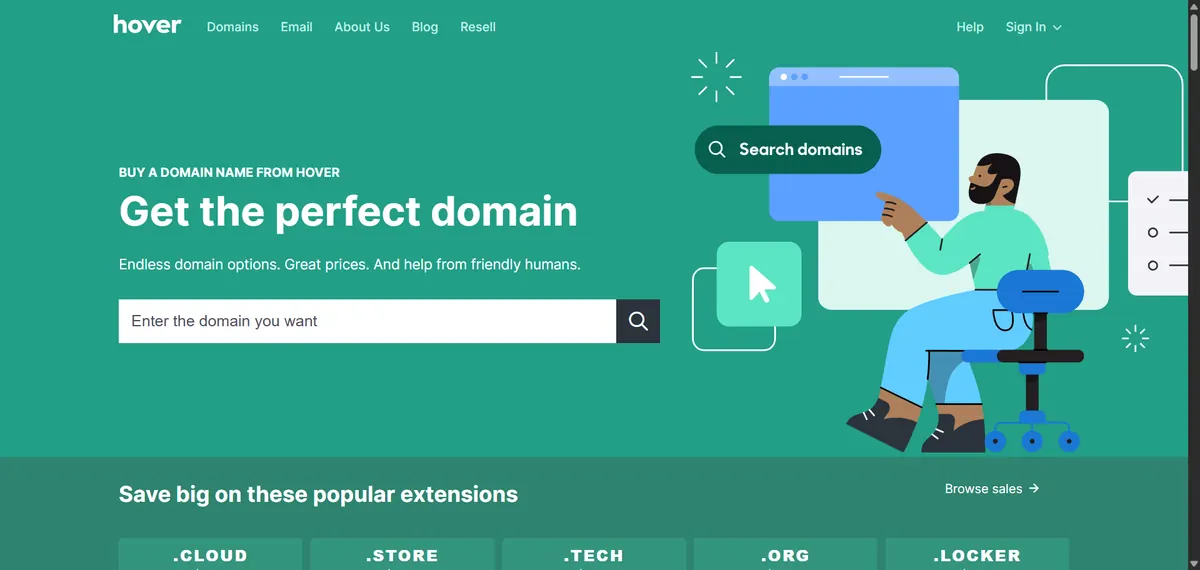
Hover’s whole identity is restraint. It sells domains and email, and that is the list. There is no hosting funnel, no website builder pitch, no cart page trying to sell you a logo. For a lot of people that alone is worth money.
Its pricing is the most transparent on this page: a .com is $18.99 to register, $18.99 to renew and $18.99 to transfer in. Identical across all three columns, published openly, with free WHOIS privacy on supported domains. Nothing to calculate.
It is also, at $18.99, the second-most expensive option here for a single domain. Hover does run volume discounts on renewals that begin at ten domains, but the entry price is the entry price. You are paying a premium for calm.
| Best for | A clean, upsell-free registrar |
| .com register | $18.99 |
| .com renewal | $18.99 |
| .com transfer | $18.99 |
| Included free | WHOIS privacy on supported domains |
| Volume discounts | Renewal discounts start at ten domains |
Pros
- Register, renew and transfer all cost exactly the same
- No upsells anywhere in the buying flow
- Free WHOIS privacy on supported domains
- Fully public price list across hundreds of extensions
Cons
- $18.99 is well above Porkbun, Dynadot or Cloudflare
- No hosting, so you will need another provider anyway
- Volume discounts only start at ten domains
- Privacy is free on supported domains, not universally
8. GoDaddy — Widest Choice and 24/7 Support
Best for: people who want an unusual extension, want to phone a human at 2am, or want everything from domain to logo to site under one roof.
GoDaddy is the largest registrar in the world — it states it manages over 82 million domains for more than 20 million customers — and that scale buys real things. Over 500 extensions, 24/7 human support by phone, chat and email, and an entire product stack sitting behind the domain.
Its inclusions have improved a lot. Free domain privacy is now standard rather than a $9.99 upsell, along with DNSSEC, registrar transfer lock, DMARC protection and domain forwarding. On features alone, GoDaddy is competitive.
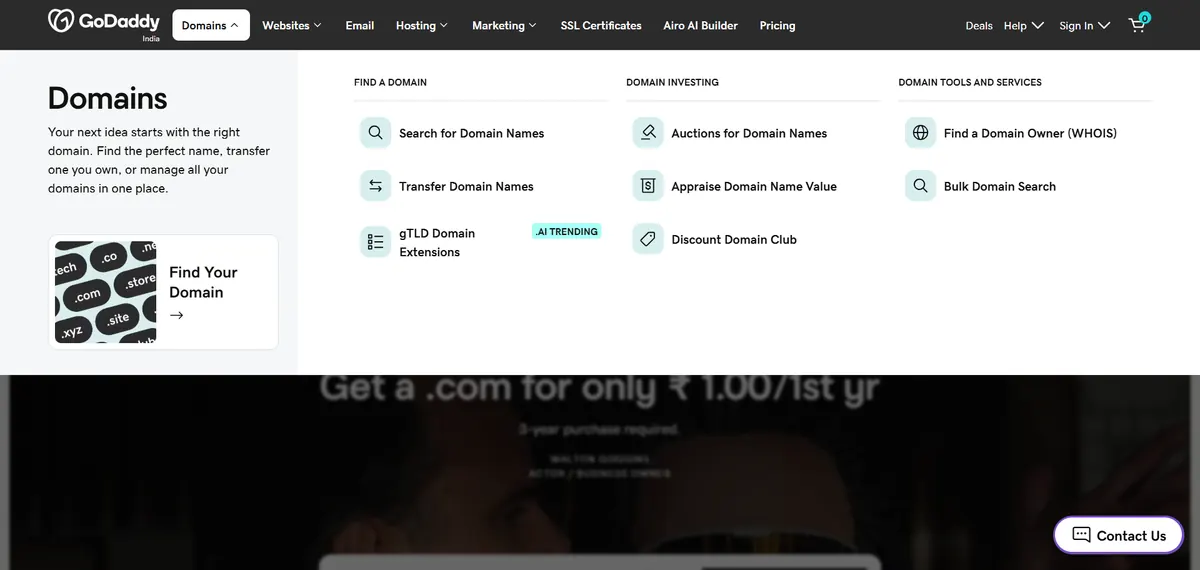
Pricing is where you have to pay attention. GoDaddy leads with aggressive first-year promotions that are explicitly new customers only, vary by market and sometimes require a multi-year purchase — its own pages carry lines like “3-year purchase required” and “additional year(s)” at the full rate directly under the headline price. We are deliberately not quoting a single first-year figure here, because the number you see depends on your country, your customer status and the term you commit to. What is consistent is the shape: a cheap first year, then the standard renewal rate.
| Best for | Extension choice, 24/7 support, bundled services |
| .com pricing | Promotional first year for new customers, then the standard renewal rate |
| Promo conditions | New customers only; some offers require a multi-year purchase |
| Extensions | Over 500 TLDs |
| Included free | Domain privacy, DNSSEC, transfer lock, DMARC, domain forwarding |
| Scale | 82M+ domains under management, 20M+ customers |
Pros
- Over 500 extensions — the widest choice here
- Genuine 24/7 human support by phone and chat
- Free domain privacy, DNSSEC and transfer lock now standard
- Free domain included with annual hosting or website builder plans
Cons
- Headline prices are first-year, new-customer only
- Some promotions require a multi-year commitment
- Renewal is where the real cost lands, and it is not the headline
- The most upsell-heavy checkout of any registrar on this list
9. IONOS — Cheapest First Year
Best for: short-term projects, test domains, and anyone who genuinely will not renew.
IONOS advertises a .com at $5.10 for the first year as an intro offer, against a regular price of $20. That is the cheapest entry point on this list, and if you need a domain for a campaign, a prototype or a one-year experiment, it is genuinely good value.
It is also the clearest illustration of why this article is organised around renewal. Registering at $5.10 and renewing at $20 means your second year costs almost four times your first. Over five years you would pay $85.10 — nearly $30 more than Porkbun’s $55.40 for the same domain, despite the cheaper headline.
The domain itself comes with a free SSL certificate, free Domain Connect for DNS setup and up to 10,000 subdomains. Notably, IONOS does not state on its domain page that private registration is included — which, in a field where seven of the ten registrars here include it as standard, is worth checking before you buy.

| Best for | The lowest possible first-year cost |
| .com first year | $5.10 intro offer |
| .com regular price | $20 |
| Included free | SSL certificate, Domain Connect, up to 10,000 subdomains |
| Privacy | Not stated as included on the domain page — verify before buying |
Pros
- Cheapest first year of any registrar here
- Free SSL certificate with the domain
- Up to 10,000 subdomains included
- Hosting, email and site tools available alongside
Cons
- $5.10 to $20 is the steepest renewal jump on this list
- WHOIS privacy is not advertised as included
- More expensive than Porkbun over any hold longer than two years
- Upsell-heavy account experience
10. WordPress.com — Best Bundled Domain
Best for: people who are building a WordPress.com site anyway and want the domain handled in the same place.
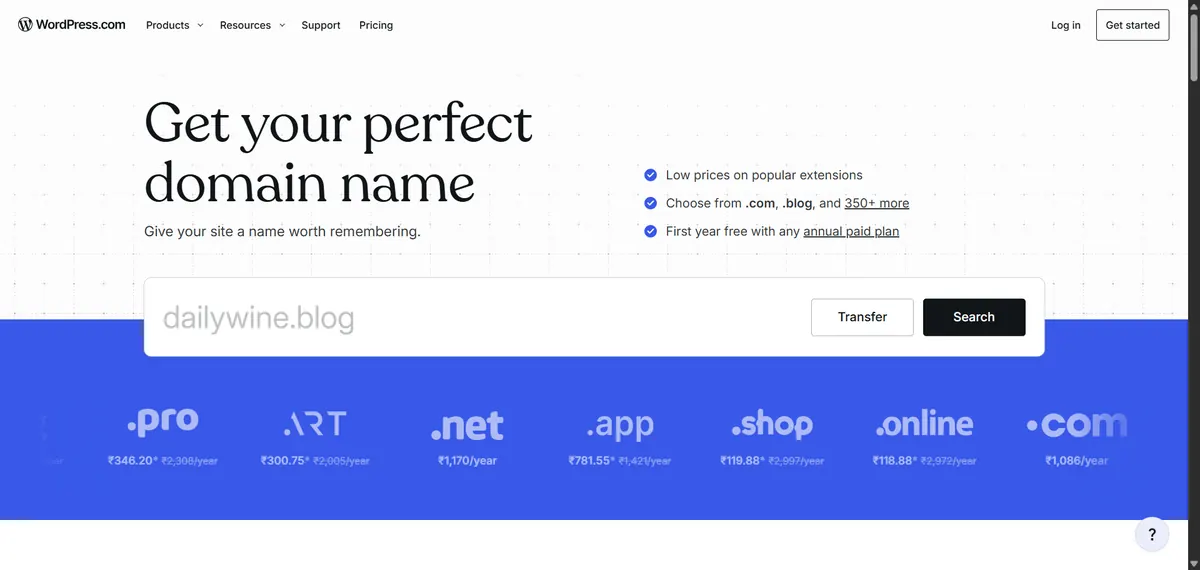
WordPress.com is not really competing on domain price, and it does not pretend to. Its offer is that the first year is free with any annual, two-year or three-year paid plan, covering most popular extensions including .com, .net, .org and .blog. After that, standard renewal rates apply. There are over 350 extensions available.
If you are paying for a WordPress.com plan regardless, a free domain in year one is a real saving and one less account to manage. If you are not, registering a domain here purely to buy it is the wrong reason — you would be choosing a registrar to get a discount on a product you did not want.
The practical consideration is portability. A domain bundled with a plan is easy to leave sitting where it is, and domains are much better kept somewhere you would choose on their own merits. If you ever leave the platform, plan to transfer the name out rather than let it lapse.
| Best for | A domain bundled with a WordPress.com site |
| First year | Free with any annual, two-year or three-year paid plan |
| After year one | Standard renewal rates apply |
| Extensions | 350+ including .com, .net, .org and .blog |
| Best avoided if | You are not buying a WordPress.com plan |
Pros
- Free domain for the first year with any annual plan
- Site, hosting and domain managed in one dashboard
- Over 350 extensions available
- Zero DNS configuration if the site lives there too
Cons
- Only good value if you are buying a plan anyway
- Renewal is at standard rates, with no published flat figure
- Not a registrar you would choose on its own merits
- Easy to leave a domain stranded on a platform you have outgrown
The Renewal Trap: Five-Year Cost Compared
Here is the calculation almost no registrar wants you to run. Take the first-year price, add four renewals, and look at what you have actually agreed to spend on a name you will very likely still own.
| Registrar | Year 1 | Years 2–5 each | Five-year total |
|---|---|---|---|
| Cloudflare | Registry and ICANN fee only, no markup | Lowest available | |
| Dynadot | $10.88 | $10.88 | $54.40 |
| Porkbun | $11.08 | $11.08 | $55.40 |
| Namecheap (new customer) | $6.79 | $18.48 | $80.71 |
| IONOS | $5.10 | $20.00 | $85.10 |
| Namecheap (standard promo) | $11.28 | $18.48 | $85.20 |
| NameSilo | $17.29 | $17.29 | $86.45 |
| Hover | $18.99 | $18.99 | $94.95 |
| Squarespace | $20.00 | $20.00 | $100.00 |
Want this for your own timeline? Our free domain renewal cost calculator lets you set the number of years, re-sorts every registrar instantly, and lets you drop in a price you have been quoted to see where it lands.
Three things fall out of that table.
The cheapest first year is not the cheapest domain. IONOS wins year one by almost six dollars and loses the five-year comparison by nearly thirty. Paying $5.10 instead of $11.08 saves you $5.98 once and costs you $29.70 by year five.
The spread is real but modest in absolute terms. From Dynadot to Squarespace is $45.60 over five years — about nine dollars a year. That is genuinely worth optimising if you hold twenty domains. If you hold one, it is less than a dollar a month, and choosing a registrar you find pleasant to use is a defensible way to spend it.
Flat-price registrars are easier to plan around. Porkbun, Hover, Squarespace and Dynadot charge the same at renewal as at registration, so the five-year number is just the first year times five. With promotional registrars you have to go and find the renewal rate yourself, which is precisely the friction the promotion is designed to create.
One caveat that applies to every row: registries raise their wholesale prices periodically, and when they do, every registrar’s price rises with them. Cloudflare is the clearest case — its price is the registry fee, so it moves the moment the registry moves. No registrar can promise a frozen price for ten years, and you should be sceptical of any that implies it.
What Should Be Free (And Usually Is Not)
The domain fee is only part of the bill. The rest depends on which of these a registrar hands you and which it sells back to you.
WHOIS privacy. Without it, the name, address, email and phone number you register with can end up in a public directory, which is how domain owners end up on spam and cold-call lists. It costs a registrar close to nothing. Porkbun, Cloudflare, Namecheap, Dynadot, NameSilo, Squarespace, Hover and GoDaddy all include it at no charge. In 2026, paying separately for WHOIS privacy is a reason to pick a different registrar.
SSL. Free certificates from Let’s Encrypt are standard across the industry, and several registrars here bundle one. Nobody should be paying for a basic domain-validated certificate.
DNS management. Every registrar on this list gives you DNS control. What differs is quality — Cloudflare’s is genuinely best-in-class, which is part of why it can afford to sell domains at cost.
Email forwarding. Forwarding you@yourdomain.com to an existing inbox is free at Porkbun, NameSilo, Dynadot and Squarespace. It is not the same as hosted email, but for a lot of small sites it is all that is needed.
Registrar lock and DNSSEC. Transfer lock prevents your domain being moved without approval, and DNSSEC protects against DNS spoofing. Both should be free and available. Turn both on the day you register.
How to Choose Between the Best Domain Registrars
Work through these in order and the decision usually makes itself.
1. Find the renewal price first. Before anything else, locate the renewal figure for the exact extension you want. If you cannot find it in under a minute on the registrar’s own site, treat that as information about the registrar.
2. Check what privacy costs. If it is an add-on, add its annual price to the domain price and compare again. That one line moves the ranking more than most people expect.
3. Decide whether you need to control your nameservers. If you do, Cloudflare Registrar is out, regardless of price. If you do not, it is the cheapest option available.
4. Match the registrar to the portfolio. One domain: Porkbun, Cloudflare or Squarespace. Five to twenty: Porkbun, Dynadot or Namecheap. Fifty or more: NameSilo or Dynadot, where volume pricing starts to matter.
5. Consider the extension, not just the .com. Renewal prices vary enormously by TLD. Hover lists .com at $18.99 and .io at $74.99. NameSilo lists .info at $29.49 regular. A cheap first year on an exotic extension can become an expensive habit.
6. Keep domains separate from hosting, if you can. It is not a rule, but if a host goes wrong, you want your domain somewhere you can point elsewhere in five minutes without a support ticket.
Six Expensive Mistakes to Avoid
Buying on the first-year price. The most common and the most expensive. The headline number is a customer-acquisition cost the registrar is paying; the renewal is the price of the product.
Letting auto-renew stay off. An expired domain can be bought by anyone, including services that specifically watch for lapsed names with traffic. Turn auto-renew on and keep a working card on file. This is the one mistake on this list that can cost you the domain itself, not just money.
Paying for WHOIS privacy. Eight of the ten registrars here include it free. If yours does not, that is a reason to move.
Registering a domain at your web host by default. It is convenient, and it also means the company you may one day want to leave controls the name people use to find you.
Ignoring the transfer rules. ICANN rules generally lock a newly registered or recently transferred domain for 60 days. If you register somewhere cheap intending to move it immediately, you cannot.
Registering for one year when you know you will keep it. Multi-year registration locks in today’s price against future registry increases, and it removes a yearly opportunity to forget.
Frequently Asked Questions
What is the best domain registrar in 2026?
For most people, Porkbun — a .com costs $11.08 to register and $11.08 to renew, with WHOIS privacy, SSL and URL forwarding included free. If you want the absolute lowest long-term cost and are happy on Cloudflare DNS, Cloudflare Registrar sells domains at registry cost with no markup. If you want a mainstream registrar with hosting and support attached, Namecheap.
Which domain registrar is cheapest?
Cloudflare, because it charges only what the registry and ICANN charge and adds no markup at registration or renewal. Among registrars that publish a flat figure, Dynadot lists a .com at $10.88 and Porkbun at $11.08. IONOS is cheapest for the first year at $5.10, but renews at $20.
Why is my domain renewal more expensive than the registration?
Because the first year was a promotion. Registrars discount the first year to win the customer and charge the standard rate afterwards. Namecheap’s .com is $6.79 for new customers and $18.48 at renewal; IONOS is $5.10 then $20. It is disclosed, but you have to go and look for it.
Do I need to pay for WHOIS privacy?
No. Porkbun, Cloudflare, Namecheap, Dynadot, NameSilo, Squarespace, Hover and GoDaddy all include it at no charge. If a registrar charges for it, you are paying roughly ten dollars a year for something the rest of the industry gives away.
Can I use my own DNS with Cloudflare Registrar?
No. Cloudflare’s documentation states that all domains registered there use Cloudflare nameservers and that you cannot switch to another DNS provider’s nameservers while the domain is with Cloudflare Registrar. If you need third-party DNS, choose a different registrar.
Is it safe to buy a domain from a small registrar?
Yes, provided it is ICANN-accredited — every registrar on this list is. Accreditation means the domain is registered in your name in the registry, and you can transfer it out if the registrar disappoints you. Size affects support hours and product range, not ownership.
Should I buy my domain from my web host?
It is convenient but not ideal. Keeping the domain at a separate registrar means a dispute or outage at your host never threatens control of the name itself. If you do register with a host, make sure you can access the DNS settings yourself.
How much should a .com cost per year?
Between roughly $10 and $20 at a reputable registrar in 2026. Below $10 is almost always a first-year promotion. Above $25 for a plain .com, with no bundled service explaining it, means you are paying for something other than the domain.
Can I transfer my domain to another registrar?
Yes. You unlock the domain, get an authorisation code and start the transfer at the new registrar, which usually adds a year to the registration. ICANN rules generally impose a 60-day lock after a new registration or a previous transfer, so a domain you registered last week cannot move yet.
Is GoDaddy a good registrar?
It is a capable one. Over 500 extensions, 24/7 human support and free domain privacy, DNSSEC and transfer lock as standard. The reservation is pricing: headline offers are first-year, new-customer only, some require a multi-year purchase, and the real cost is the renewal. Find that number before you buy.
What happened to Google Domains?
It was sold to Squarespace, which now runs Squarespace Domains. The interface and the all-inclusive pricing approach carried over — one flat price with WHOIS privacy, SSL, premium DNS and email forwarding included — which is why it is the most natural home for former Google Domains customers.
Does registering a domain for multiple years help SEO?
There is no confirmed ranking benefit. The reason to register for several years is practical: you lock in today’s price against registry increases and you remove several chances to forget a renewal. Treat it as risk management, not as an SEO tactic.
How We Compared These Registrars
This is a research-based comparison. Etemora does not hold an account at all ten registrars, and we are not claiming to have transferred a domain through each one.
What we did do:
- Read every price directly off the registrar’s own published pricing page in September 2026, and recorded the terms each figure assumes
- Separated registration, renewal and transfer prices wherever a registrar publishes them separately
- Calculated a five-year cost for every registrar that publishes both a first-year and a renewal figure
- Declined to publish a first-year price for GoDaddy, because its promotional rate varies by market and customer status and no single figure would be accurate
- Removed a widely repeated “GoDaddy .com for one cent” claim after finding no first-party source supporting it as a general US price
- Flagged where a registrar’s own site contradicts itself — NameSilo describes WHOIS privacy as free on its pricing page and as an add-on in one FAQ answer
The weighting behind the scores:
| Factor | Weight | What we looked at |
|---|---|---|
| Total cost of ownership | 30% | Five-year cost, not the first-year headline |
| Pricing transparency | 25% | Is the renewal price published, findable and honoured? |
| Included features | 20% | Privacy, SSL, DNS, email forwarding, DNSSEC, transfer lock |
| Control and portability | 15% | Nameserver freedom, transfer process, account security |
| Experience and support | 10% | Interface quality, upsell pressure, support availability |
Our editorial scores reflect how well a registrar serves the job we recommend it for. A registrar scoring 7.5 is not a bad registrar — it is a narrower fit. Affiliate relationships played no part in the order: Cloudflare, which runs no affiliate programme for its registrar, sits second.
Before you buy: open the registrar’s price page, find the renewal figure for your exact extension, multiply it by five, and add the cost of WHOIS privacy if it is not free. That number — not the one on the banner — is the price of the domain.
Browse more hosting guides →Sources
Every price and feature claim in this article was read from the registrar’s own published pages in September 2026:
- Porkbun — domain pricing
- Cloudflare — Registrar and Cloudflare developer documentation
- Namecheap — .com pricing
- Dynadot — domain prices
- NameSilo — pricing
- Squarespace — domain pricing
- Hover — domain price list
- GoDaddy — domains
- IONOS — domain names
- WordPress.com — domains
Setting up the rest of your site? Our other guides cover the best website builders, the Hostinger vs WP Engine comparison, the best cloud storage services and the best password managers.
Editorial note: this article is general information, not a personalised recommendation. Etemora does not resell domains and has not been paid to rank these registrars in any particular order. Every price was checked against the registrar’s own published page in September 2026, is US pricing unless stated otherwise, and may have changed since — always confirm before purchasing.