
Why Domain Renewal Prices Go Up (and 7 Ways to Pay Less)
 By M. Zaid
- Updated September 26, 2026
- 11 min read
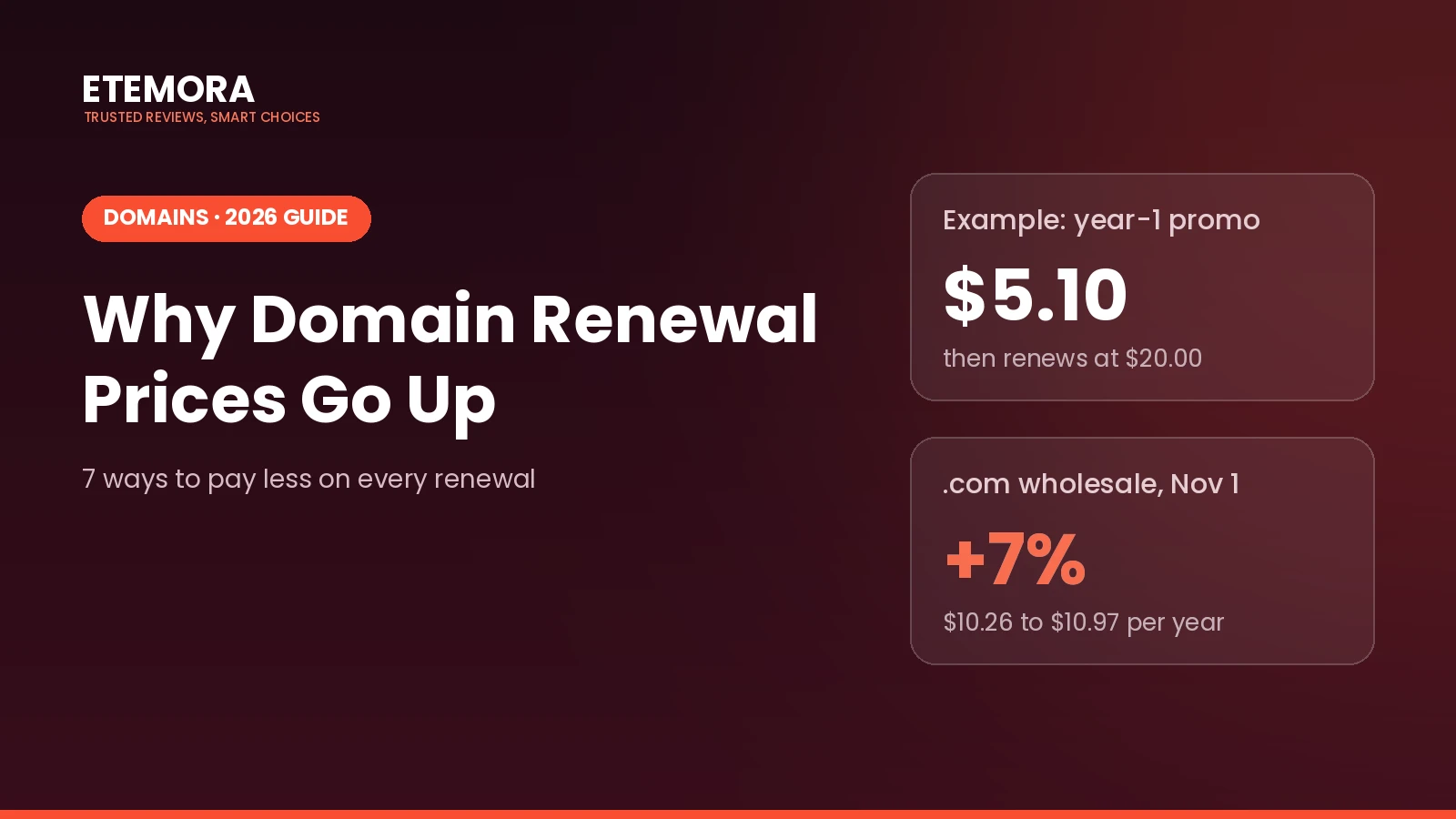
Quick answer: Your domain renewal price is usually higher than what you paid in year one for three reasons: the first year was a promotional discount, the registry that runs the extension raised its wholesale price, or add-ons you picked at checkout renew with the domain. For .com, the wholesale price rises from $10.26 to $10.97 on November 1, 2026, so most registrars will charge more after that date. The simplest ways to pay less are to choose a registrar whose domain renewal price equals its first-year price, renew for several years before a price rise, and switch off add-ons you don’t use.
Buying a domain is cheap. Keeping it is where the real cost sits. Many people pay under $10 for their first year, then see a renewal notice for $18, $20 or more and assume something went wrong.
Nothing went wrong. The domain renewal price is simply a different number from the first-year price, and most registrars show you the smaller one first. This guide explains where the jump comes from, what is changing for .com in November 2026, and seven practical ways to keep your renewals low.
Why Your Domain Renewal Price Is Higher Than Year One
There are three main reasons a renewal costs more than the first registration. Most price jumps come from one or more of them.
1. The first year was a promotional price
Many registrars sell the first year below their normal price to win new customers, then charge the standard rate on renewal. The discount is real, but it only lasts for the first term.
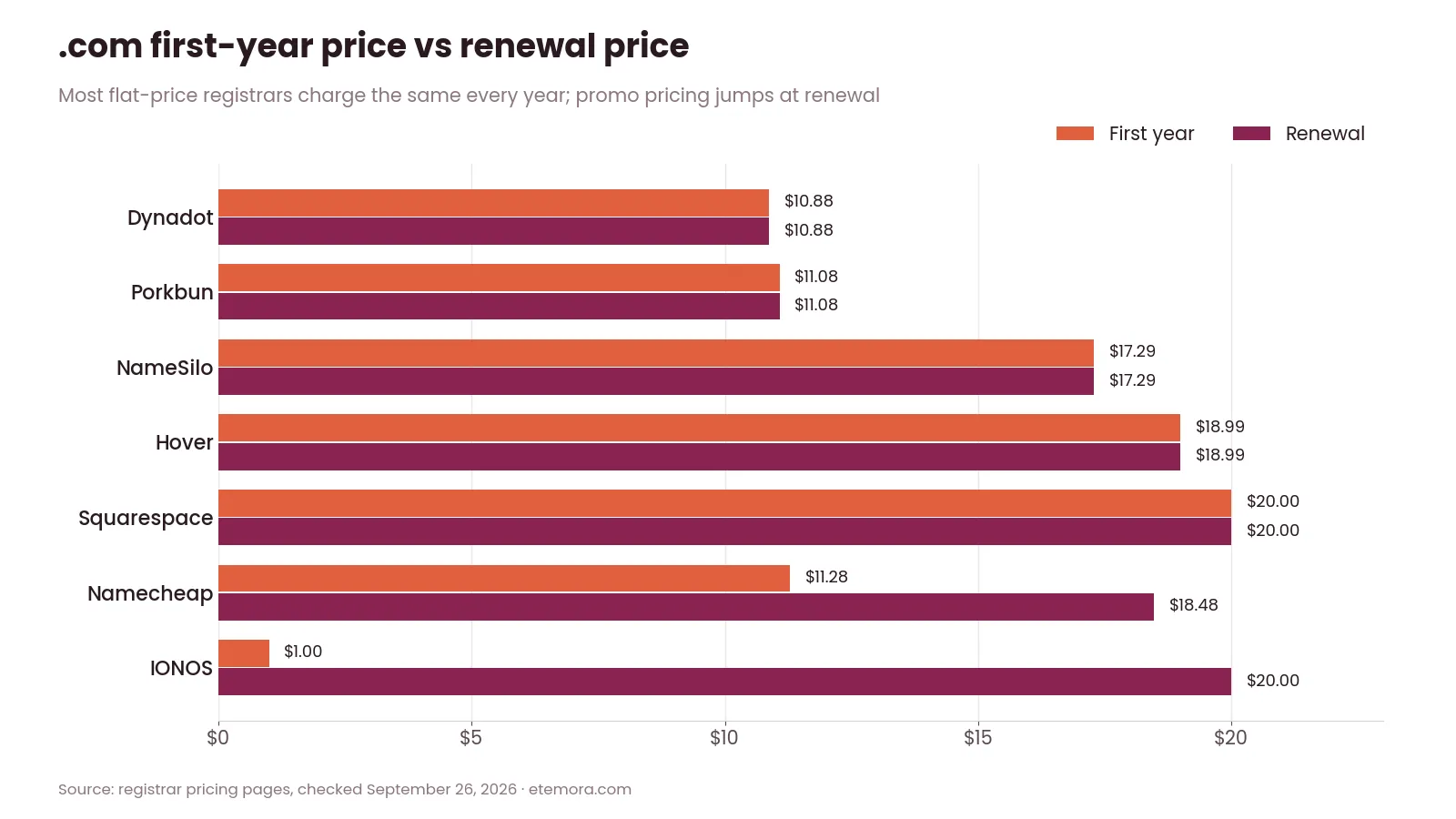
In our comparison of the best domain registrars, prices were read from each registrar’s own pricing page in September 2026. A few examples for a standard .com:
- Namecheap: $11.28 for the first year, $18.48 on renewal
- IONOS: $1 for the first year, $20 on renewal
- Porkbun: $11.08 for the first year and $11.08 on renewal
The first two look cheap at checkout, but both renew for noticeably more. Porkbun charges the same price every year.
2. The registry raised its wholesale price
Registrars don’t own the extensions they sell. Each extension is run by a registry, and the registry charges registrars a wholesale fee for every domain-year. When the registry raises that fee, registrars usually pass it on to you at your next renewal.
For .com, the registry is Verisign. That is why .com prices across the whole market tend to rise at the same time.
3. Add-ons renew with the domain
Extras chosen at checkout, such as business email, SSL certificates, “premium DNS”, site builders or domain protection bundles, often renew on the same date as the domain. On the renewal invoice, they can look like part of the domain price.
The .com Price Increase on November 1, 2026
Verisign is raising the wholesale price of a .com domain from $10.26 to $10.97 per year, effective November 1, 2026, according to Domain Name Wire. That is a 7% increase.
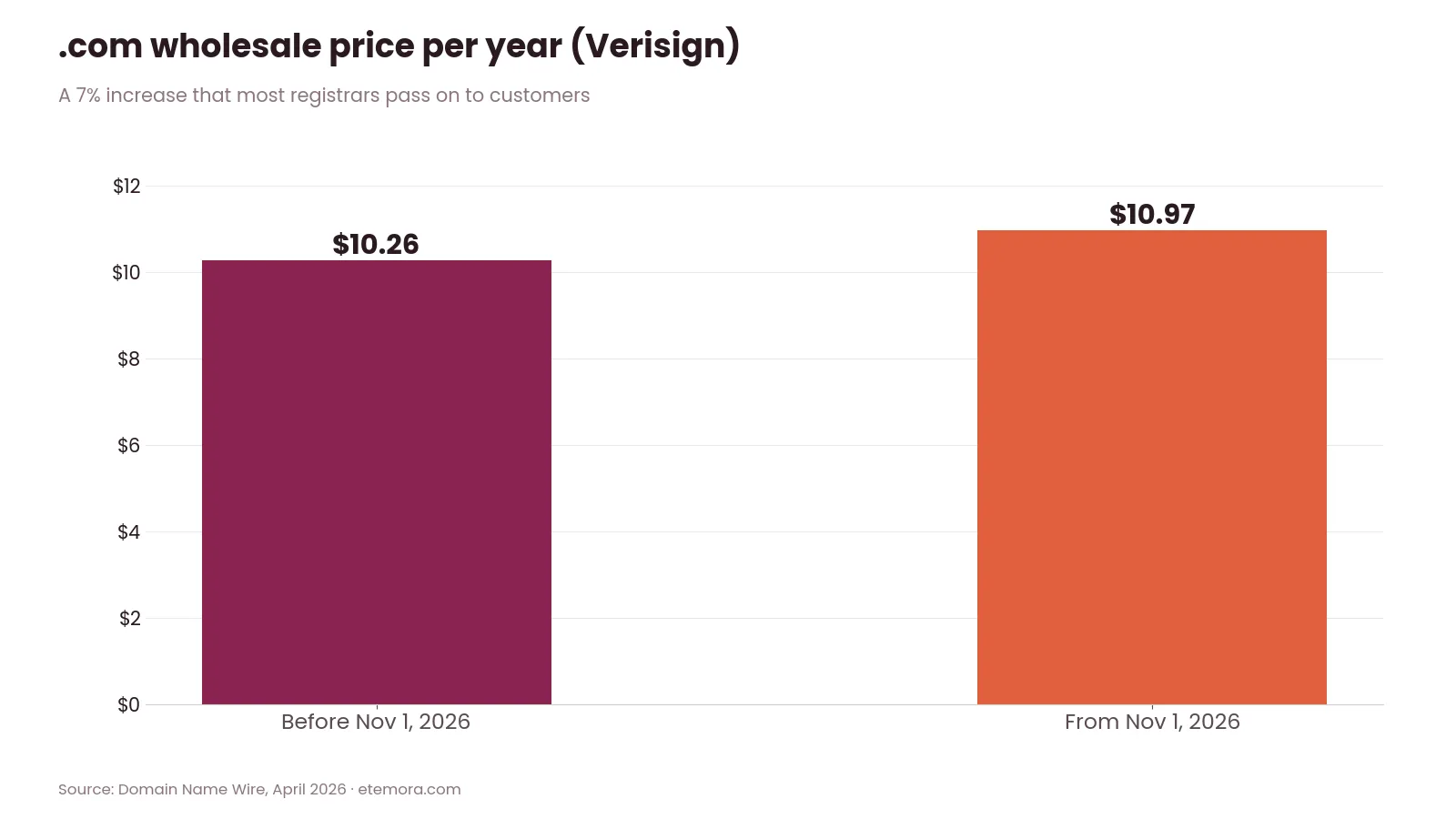
Verisign’s agreement allows it to raise the .com price by up to 7% in each of the last four years of every six-year pricing period. Porkbun’s knowledge base explains the same rule and expects further annual increases if Verisign uses the full allowance.
What this means for you:
- Expect most registrars to raise .com prices on or after November 1, 2026. The exact retail change depends on each registrar.
- Renewals charged before that date are billed at the current price.
- More increases may follow in later years, so a price you see today is not guaranteed next year.
Which Registrars Keep Domain Renewal Prices Fair?
If your main goal is avoiding a big jump after year one, look for registrars where the domain renewal price matches the first-year price. The table below uses .com prices from our registrar comparison, read from each registrar’s pricing page in September 2026, before the November wholesale increase.
| Registrar | First year | Renewal | Renewal jump |
|---|---|---|---|
| Cloudflare | At cost | At cost | None (no markup) |
| Dynadot | $10.88 | $10.88 | None |
| Porkbun | $11.08 | $11.08 | None |
| NameSilo | $17.29 | $17.29 | None |
| Hover | $18.99 | $18.99 | None |
| Squarespace | $20.00 | $20.00 | None |
| Namecheap | $11.28 | $18.48 | +$7.20 |
| IONOS | $1.00 | $20.00 | +$19.00 |
Cloudflare Registrar charges only what the registry and ICANN charge, with no markup, so its renewals follow the wholesale price exactly. The trade-off is that your domain must use Cloudflare’s DNS.
Flat pricing doesn’t make a registrar the cheapest overall. Squarespace and Hover renew at the same price every year, but that price is higher than Porkbun’s or Dynadot’s. The point is predictability: you know the renewal cost before you buy.
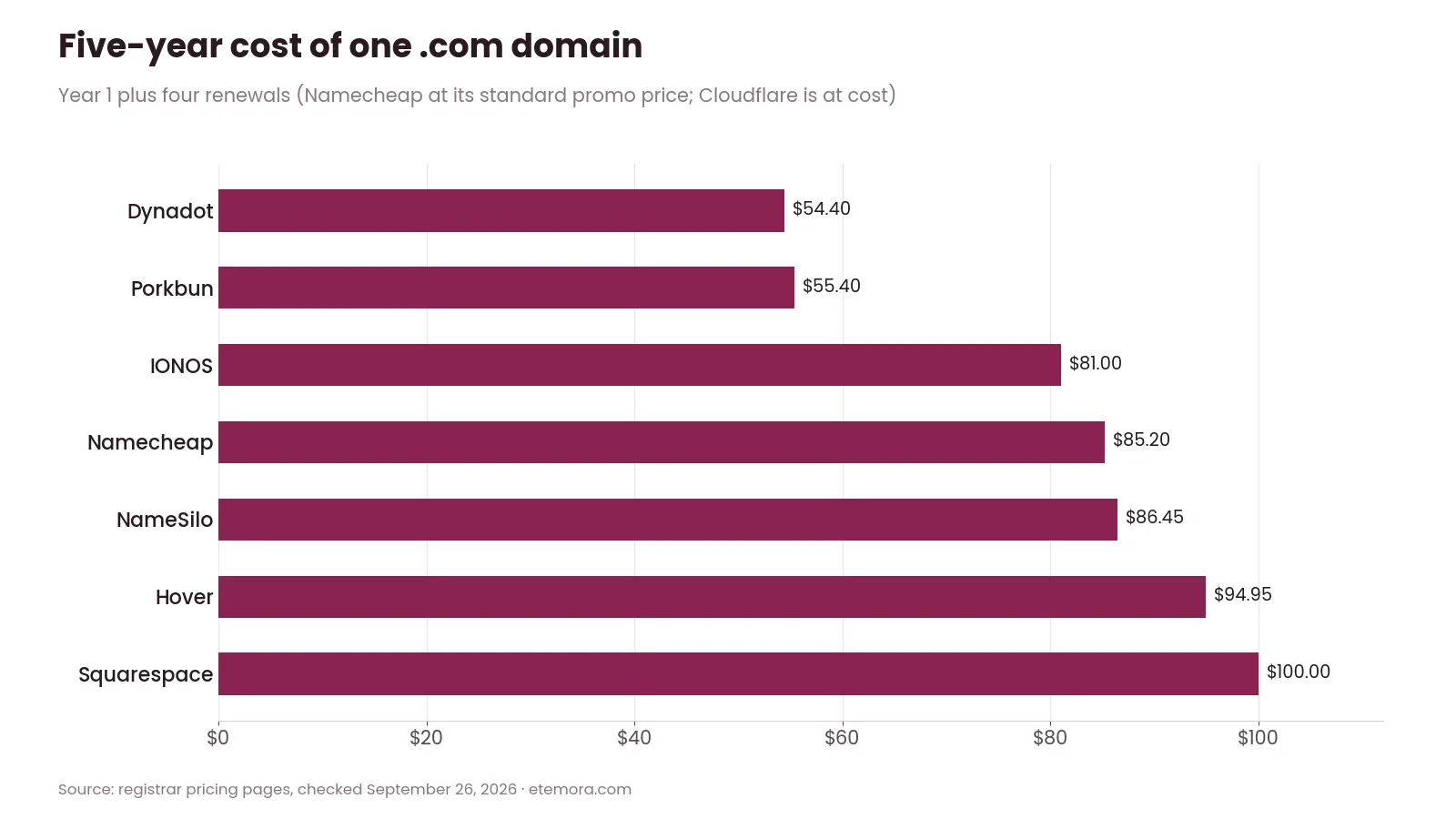
Over five years, the gap in domain renewal price adds up. A .com at Dynadot or Porkbun costs about $55 over five years, while the same name at IONOS, Namecheap or NameSilo costs $81 to $87.
Want to see what your domain will cost over 5 or 10 years?
Try the Renewal Cost Calculator →Domain Renewal Price by Extension
The domain renewal price also depends on the extension. Each registry sets its own wholesale price, and some extensions cost several times more than a .com to keep. Even registrars known for flat .com pricing run first-year sales on other extensions.
Here is what Porkbun listed for common extensions in September 2026:
| Extension | First year | Renewal |
|---|---|---|
| .com | $11.08 | $11.08 |
| .net | $12.52 | $12.52 |
| .org | $7.98 (sale) | $11.84 |
| .dev | $8.75 (sale) | $12.87 |
| .app | $8.75 (sale) | $14.93 |
| .xyz | $2.04 (sale) | $14.21 |
| .info | $3.60 (sale) | $22.14 |
| .co | $15.76 (sale) | $31.20 |
| .io | $28.12 (sale) | $51.80 |
Source: Porkbun’s domain pricing page, September 2026.
Two patterns stand out. First, cheap first-year offers on extensions like .xyz and .info can renew at five or six times the sale price. Second, startup favorites such as .io and .co cost far more to renew than a .com, so a short, catchy name can become one of your bigger yearly costs.
Before registering anything other than a .com or .net, check the renewal column first. If the domain is for a long-term business, the renewal cost matters more than the launch discount.
7 Ways to Pay Less on Domain Renewals
1. Compare the renewal price, not the first-year price
Before you buy, find the domain renewal price on the registrar’s pricing page, not just the checkout banner. Multiply it by the number of years you expect to keep the domain. Our domain registrar comparison tool puts the key numbers side by side.
2. Renew for several years before a price rise
Most registrars let you renew a domain for multiple years at once, up to a maximum of 10 years of registration. Renewing ahead of the November 1, 2026 .com increase locks the current price for every year you pay for now.
3. Transfer to a registrar with lower or flat renewals
If your current registrar charges a high domain renewal price, you can move the domain. For most extensions, including .com, a transfer adds one year to your registration, so you are not paying twice. Our step-by-step guide on how to transfer a domain to another registrar covers the process.
4. Switch off add-ons you don’t use
Check your account for bundled extras that renew automatically, such as paid email, SSL, or protection packages. Many registrars now include WHOIS privacy for free, so paying for it separately is often unnecessary.
5. Keep auto-renew on, but check the price each year
Auto-renew protects you from losing the domain. Letting a domain expire can lead to extra restore fees or losing the name altogether. Keep auto-renew switched on, and put a reminder in your calendar a month before renewal to check the price.
6. Be careful with first-year coupons
Coupon codes usually apply to the first year only. A coupon can make an expensive registrar look cheap on day one while leaving the full renewal price untouched.
7. Use volume pricing if you own many domains
Some registrars lower their prices as you hold more domains. NameSilo, for example, publishes tiered pricing that falls with volume. If you manage a portfolio, consolidating it at one registrar can reduce the cost per domain.
How to Check Your Domain Renewal Price
- Log in to your registrar and open the domain’s settings page.
- Find the domain renewal price and the renewal date. Some registrars show this on the domain list, others in the billing section.
- Check which add-ons renew with it, such as email, SSL or privacy.
- Compare with a flat-price registrar using the same extension.
- Decide: renew for several years, remove add-ons, or transfer the domain.
If you are still choosing where to host the site that will use the domain, our guide to the best web hosting services compares hosting renewal prices the same way.
Frequently Asked Questions
Why is my domain renewal price so high?
Usually because the first year was a promotional price, the registry raised its wholesale price, or add-ons such as email or SSL renew with the domain. Check your renewal invoice line by line to see which one applies.
How much should a .com domain cost to renew?
Before November 1, 2026, the .com domain renewal price at registrars with flat pricing ranged from about $10.88 to $20 in our September 2026 comparison. After the wholesale increase, expect most prices to rise slightly.
Is the .com price going up in 2026?
Yes. Verisign’s wholesale .com price rises from $10.26 to $10.97 per year on November 1, 2026. Most registrars are expected to pass this on to customers.
Can I lock in my domain renewal price?
You can’t lock a price forever, but renewing for several years at once, up to a maximum of 10 years of registration, fixes the price for the years you pay for.
Which domain registrar has the cheapest renewals?
Cloudflare charges the registry’s price with no markup. Among registrars with a published flat price, Dynadot and Porkbun had the lowest .com renewals in our September 2026 comparison.
Does transferring a domain save money?
It can. Moving to a registrar with a lower renewal price reduces future costs, and for .com and most generic extensions the transfer fee includes one extra year of registration.
What happens if I don’t renew my domain?
The domain expires. Registrars usually offer a grace period, but restoring a domain later can cost extra, and if it is released it may be registered by someone else.
Is the domain renewal price the same for every extension?
No. Each registry sets its own wholesale price. At Porkbun in September 2026, a .com renewed for $11.08, a .co for $31.20 and a .io for $51.80.
Is WHOIS privacy an extra renewal cost?
At many registrars it is free. Porkbun, Namecheap, Cloudflare and several others include it at no charge, so check whether you are paying for it separately.
The Bottom Line
A higher domain renewal price usually isn’t a mistake. It’s the gap between a discounted first year and the registrar’s normal price, plus any registry increases and add-ons.
To compare options side by side, start with our best domain registrars guide or the renewal cost calculator.
How we put this together: this guide is research-based. Registrar prices come from our September 2026 registrar comparison, where each figure was read from the registrar’s official pricing page. The .com wholesale change is based on reporting by Domain Name Wire and Porkbun’s published explanation. Prices change, so confirm the final figure at checkout.
Disclosure: Some links on this page may be affiliate links. If you purchase through an eligible link, Etemora may earn a commission at no additional cost to you. Our editorial recommendations are not determined solely by commission. Learn more →
Related articles you may like
 Web HostingHostinger vs WordPress.com: 2026 Honest Comparison
 Web HostingHow to Buy a Domain Name in 2026: 8 Simple Steps
 Web HostingLargest Domain Registrars in 2026 (Ranked by .com Domains)
 SecurityMost Secure Domain Registrars in 2026: 2FA, Locks and Privacy Compared
 Web HostingHow to Transfer a Domain to Another Registrar (Step by Step)
 Web HostingHostinger vs Bluehost: Full Comparison in 2026