
AI Writing Pattern Checker
Paste your text to spot the phrases and habits that make writing sound machine-made — and get tips to make it sound like you. Runs in your browser; nothing is sent or saved.
- 100+ AI-style phraseswith plainer swaps
- Nothing sent or savedruns in your browser
- 100% freeno sign-up
%22%2F%3E%3Cg%3E%3Crect%20x%3D%2276%22%20y%3D%2248%22%20width%3D%22190%22%20height%3D%22240%22%20rx%3D%2218%22%20fill%3D%22%232A0A16%22%20opacity%3D%22.35%22%2F%3E%3Cpath%20d%3D%22M88%2040h132l40%2040v182a18%2018%200%200%201-18%2018H88a18%2018%200%200%201-18-18V58a18%2018%200%200%201%2018-18z%22%20fill%3D%22url(%23t2a10W)%22%2F%3E%3Cpath%20d%3D%22M220%2040v26a14%2014%200%200%200%2014%2014h26%22%20fill%3D%22%23E7D3DA%22%2F%3E%3Crect%20x%3D%2292%22%20y%3D%2298%22%20width%3D%22146%22%20height%3D%228%22%20rx%3D%224%22%20fill%3D%22%23E3CFD6%22%2F%3E%3Crect%20x%3D%2292%22%20y%3D%22118%22%20width%3D%22146%22%20height%3D%228%22%20rx%3D%224%22%20fill%3D%22%23E3CFD6%22%2F%3E%3Crect%20x%3D%2292%22%20y%3D%22138%22%20width%3D%22146%22%20height%3D%228%22%20rx%3D%224%22%20fill%3D%22%23E3CFD6%22%2F%3E%3Crect%20x%3D%2292%22%20y%3D%22158%22%20width%3D%2288%22%20height%3D%228%22%20rx%3D%224%22%20fill%3D%22%23E3CFD6%22%2F%3E%3Crect%20x%3D%2286%22%20y%3D%22222%22%20width%3D%22158%22%20height%3D%2240%22%20rx%3D%2210%22%20fill%3D%22%23E8452C%22%2F%3E%3Ctext%20x%3D%22165.0%22%20y%3D%22250%22%20text-anchor%3D%22middle%22%20font-family%3D%22Poppins%2CArial%2Csans-serif%22%20font-size%3D%2222%22%20font-weight%3D%22800%22%20fill%3D%22%23fff%22%3ECHECK%3C%2Ftext%3E%3C%2Fg%3E%3Crect%20x%3D%2292%22%20y%3D%22118%22%20width%3D%22120%22%20height%3D%2210%22%20rx%3D%225%22%20fill%3D%22%23FF8A5B%22%20opacity%3D%22.8%22%2F%3E%0A%3Cg%3E%3Ccircle%20cx%3D%22286%22%20cy%3D%22176%22%20r%3D%2256%22%20fill%3D%22url(%23t2a10A)%22%20opacity%3D%22.9%22%2F%3E%3Ccircle%20cx%3D%22286%22%20cy%3D%22176%22%20r%3D%2256%22%20fill%3D%22none%22%20stroke%3D%22%23FFB08F%22%20stroke-width%3D%2210%22%2F%3E%3Cpath%20d%3D%22M326%20216l40%2040%22%20stroke%3D%22url(%23t2a10C)%22%20stroke-width%3D%2222%22%20stroke-linecap%3D%22round%22%2F%3E%3Cpath%20d%3D%22M270%20150a24%2024%200%200%201%2030-6%22%20stroke%3D%22%23FFD9C8%22%20stroke-width%3D%226%22%20stroke-linecap%3D%22round%22%20fill%3D%22none%22%2F%3E%3C%2Fg%3E%0A%3Cpath%20d%3D%22M330%2050l8%2020%2020%208-20%208-8%2020-8-20-20-8%2020-8z%22%20fill%3D%22url(%23t2a10D)%22%2F%3E%3Cpath%20d%3D%22M40%2080l5%2012%2012%205-12%205-5%2012-5-12-12-5%2012-5z%22%20fill%3D%22%23FF8A5B%22%2F%3E%3C%2Fsvg%3E)
This tool does not give an “AI probability” score. No tool can reliably prove who or what wrote a text, so it shows you the patterns instead and lets you judge.
What to change
Your text, with flagged phrases highlighted
Private by design. Your text is analysed on this page only. It is not uploaded, stored or used to train anything.
What this is — and isn’t. It flags patterns that are common in AI-generated drafts and in formulaic human writing: stock phrases, heavy transition words, sentences of very similar length and repeated openings. A human can trigger every signal, and edited AI text can pass all of them. Never use the result to accuse someone of using AI.
How it works
Check your draft in three quick steps.
- Paste at least 80 words
The check runs in your browser; nothing is sent or saved.
- Read the pattern summary
See how many AI-style patterns your text has.
- Rewrite flagged phrases
Hover a highlight to see a plainer alternative.
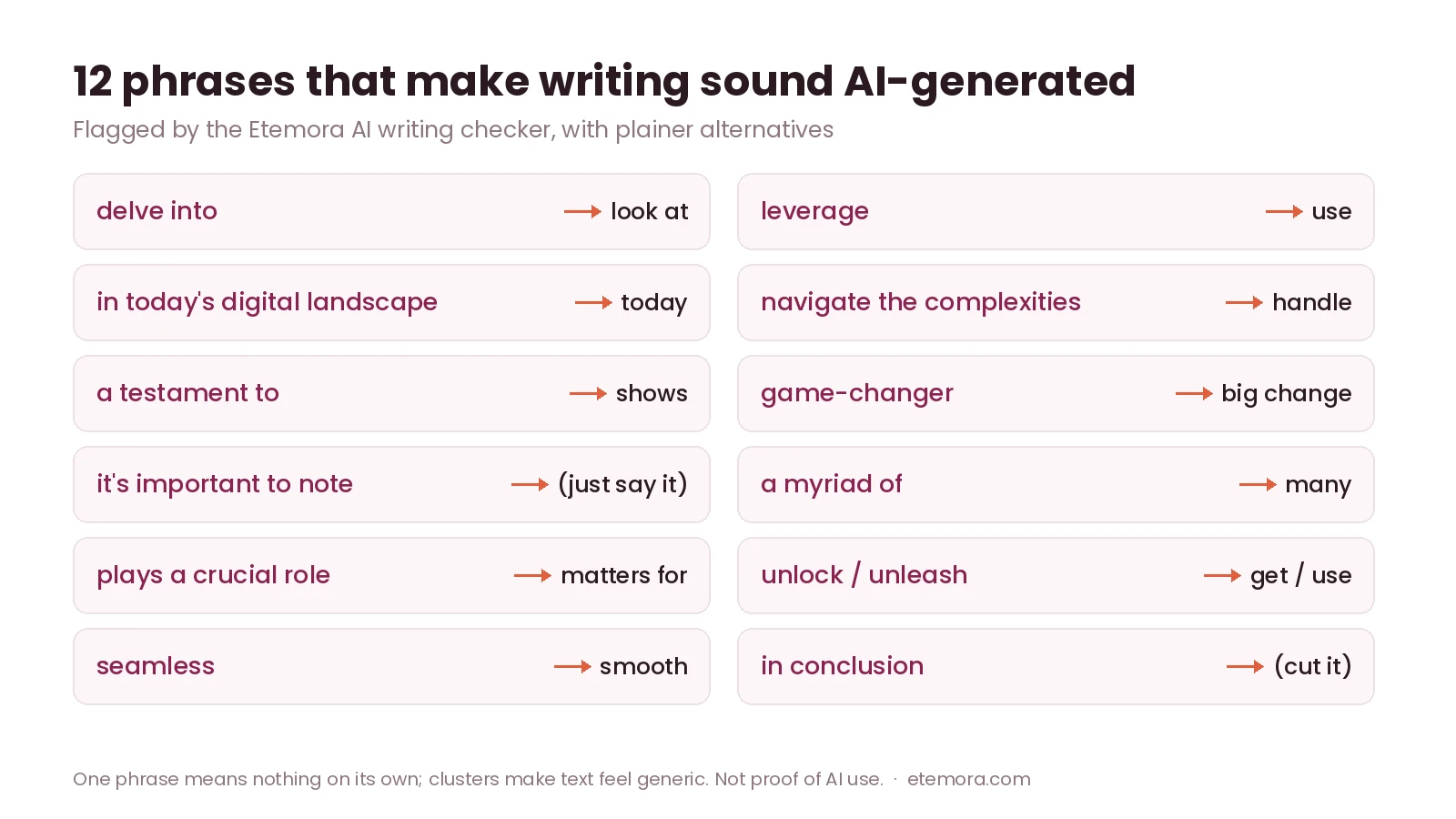
What the AI writing checker looks at
Stock phrases. Words and phrases that turn up again and again in AI drafts — “delve into”, “in today’s digital landscape”, “a testament to”, “seamless”, “it’s important to note”. One on its own means nothing; a cluster of them makes writing feel generic.
Transition overload. “Furthermore”, “Moreover”, “Additionally” and “In conclusion” at the start of sentence after sentence.
Sentence rhythm. People naturally mix short and long sentences. Text where almost every sentence is a similar length reads flat, and it is a common trait of unedited AI output.
Repeated openings and dashes. Many sentences starting with the same word, and heavy use of em dashes, are two more habits the checker counts.
Why no tool can prove text is AI-written
AI detectors guess from statistical patterns, and they make mistakes in both directions. OpenAI withdrew its own AI text classifier in 2023, citing its low rate of accuracy. A Stanford-led study found that popular GPT detectors wrongly flagged a large share of essays by non-native English writers as AI-generated. That is why this tool shows you patterns you can see and fix, rather than a percentage that looks precise but isn’t.
How to use it
Paste at least 80 words — a few paragraphs work best — and press Check writing. You will see how many signals were found, the numbers behind each one, and your text with flagged phrases highlighted. Hover over a highlight to see a plainer alternative. Edit your draft, paste it again and compare.
How to make writing sound more human
Say the specific thing: replace “plays a crucial role in enhancing productivity” with what actually happens and by how much. Cut transition words you would not use when talking. Vary sentence length on purpose — a short sentence after two long ones lands harder. Add what only you know: an example, a number, a decision you made and why. If you draft with AI, our guide to the best AI writing tools covers which assistants are easiest to steer toward a natural voice.
Sources: OpenAI – AI text classifier (update, July 2023), Liang et al., “GPT detectors are biased against non-native English writers” (2023).
AI writing checker: frequently asked questions
Is this an AI detector?
Not in the usual sense. It does not claim to know whether a human or an AI wrote your text, and it gives no AI percentage. It highlights writing patterns that are common in AI drafts so you can edit them. That makes it useful for improving your own writing, not for judging someone else’s.
Can AI detectors be trusted?
Not on their own. Detectors can label human writing as AI and miss AI text that has been edited. OpenAI withdrew its own classifier for low accuracy, and research has shown detectors are biased against non-native English writers. Treat any detector result as a hint, never as proof.
Is my text stored or shared?
No. The analysis runs entirely in your browser. Your text is not uploaded to Etemora or any other service, and it is gone when you close or refresh the page.
Why was my own writing flagged?
Because the signals are habits, not fingerprints. Formal, academic and SEO-style writing often uses the same stock phrases and even rhythm that AI tools produce. If your text is flagged, the tips show what to change if you want it to sound more personal.
How much text do I need?
At least 80 words, but 200 words or more gives more meaningful results. Very short texts do not have enough sentences to judge rhythm or repetition.
Writing with AI tools? Compare them in our best AI writing tools and best AI chatbots guides, or count words and reading time with the free word counter.
Other free tools
Guides related to this tool
 AI ToolsBest AI Writing Tools in 2026: 10 Tools Compared
 AI ToolsBest AI Chatbots in 2026: 10 AI Chatbots Compared
 FreelancingUpwork Fees Explained: Complete 2026 Guide