
Hostinger vs Bluehost: Full Comparison in 2026
 By M. Zaid
- Updated September 27, 2026
- 15 min read
Quick answer: Hostinger and Bluehost are both aimed heavily at beginners, WordPress users and small businesses, but their current plans take slightly different approaches. Hostinger emphasizes low introductory pricing, multiple websites, AI tools, CDN, backups and a broader range of hosting options — its Premium plan is currently listed at $2.99/month on a 48-month term, renewing at $10.99/month. Bluehost puts more emphasis on WordPress-oriented setup, beginner-friendly tools and a comparatively lower renewal rate on its entry shared plan — its Starter plan is currently listed at $3.99/month on a 36-month term, renewing at $9.99/month. Neither $2.99 nor $3.99 is the whole cost of hosting — that’s what this comparison breaks down.
Choosing web hosting looks easy until you open two pricing pages side by side. Nearly every host advertises a low monthly figure, but that number almost always depends on paying for one, three or four years up front — and the renewal price underneath it is often much higher.
You need to look at introductory price, billing commitment, renewal price, number of websites, storage, backups, SSL, security, CDN, WordPress features, and support — not just the number in the headline. That’s what this comparison does.
Compare Hostinger Plans → Compare Bluehost Plans →
Hostinger vs Bluehost at a Glance
| Feature | Hostinger | Bluehost |
|---|---|---|
| Entry plan compared | Premium | Starter |
| Intro price | $2.99/mo | $3.99/mo |
| Required term | 48 months | 36 months |
| Renewal price | $10.99/mo | $9.99/mo |
| Websites | 3 | 10 |
| Storage | 20 GB SSD | 10 GB NVMe |
| Free domain | 1st year on eligible term | 1st year |
| Free SSL | Yes | Yes on current plans |
| CDN | Included | Included |
| Backups | Weekly on Premium | Weekly on current Starter |
| AI website tools | Yes | Yes |
| WordPress | Yes | Yes |
| Migration | Yes | Yes |
| Money-back guarantee | 30 days | 30 days |
| 24/7 support | Yes | Yes |
Note: exact features can vary by country, billing term and plan, so the checkout page should always be treated as the final source before purchase. Hostinger’s comparison page also notes pricing varies by market, shown here as of September 2026.
Hostinger vs Bluehost Pricing
Pricing is probably the first thing people search for when comparing these two hosts. But it’s also where hosting comparisons can become misleading — both companies advertise discounted introductory rates that require a longer initial commitment.
Hostinger Pricing
Hostinger currently lists its Premium plan at $2.99/month on a 48-month term ($143.52 for the initial term), renewing at $10.99/month. It includes 3 websites, 20 GB SSD storage, a free domain for one year, weekly backups, CDN and AI tools. Its higher Unlimited plan is listed at $3.99/month on 48 months and renews at $16.99/month; Cloud Startup starts at $7.99/month on 48 months and renews at $25.99/month.
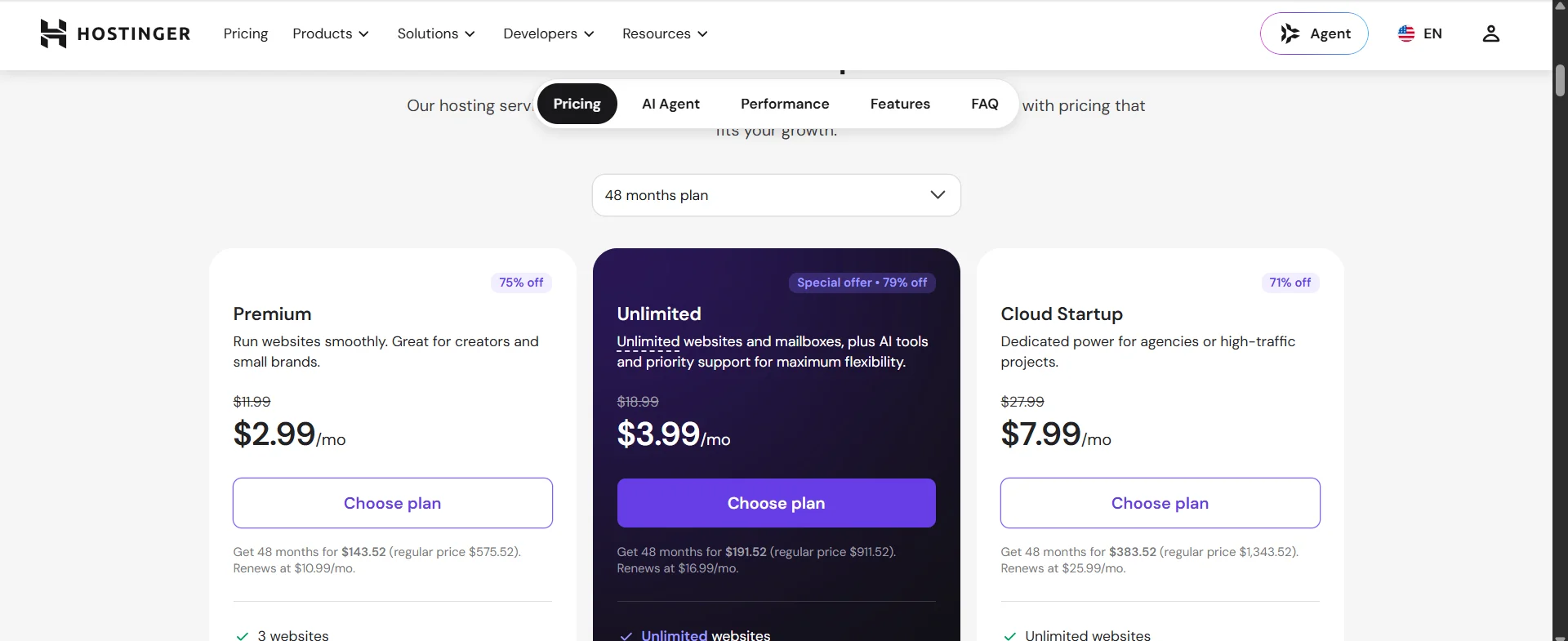
The important catch: the headline $2.99 price is only available with a four-year commitment. The actual initial payment is around $143.52, and after that the renewal becomes much more important than the advertised rate.
Ready to lock in Hostinger’s lower starting price?
See Hostinger Plans →Bluehost Pricing
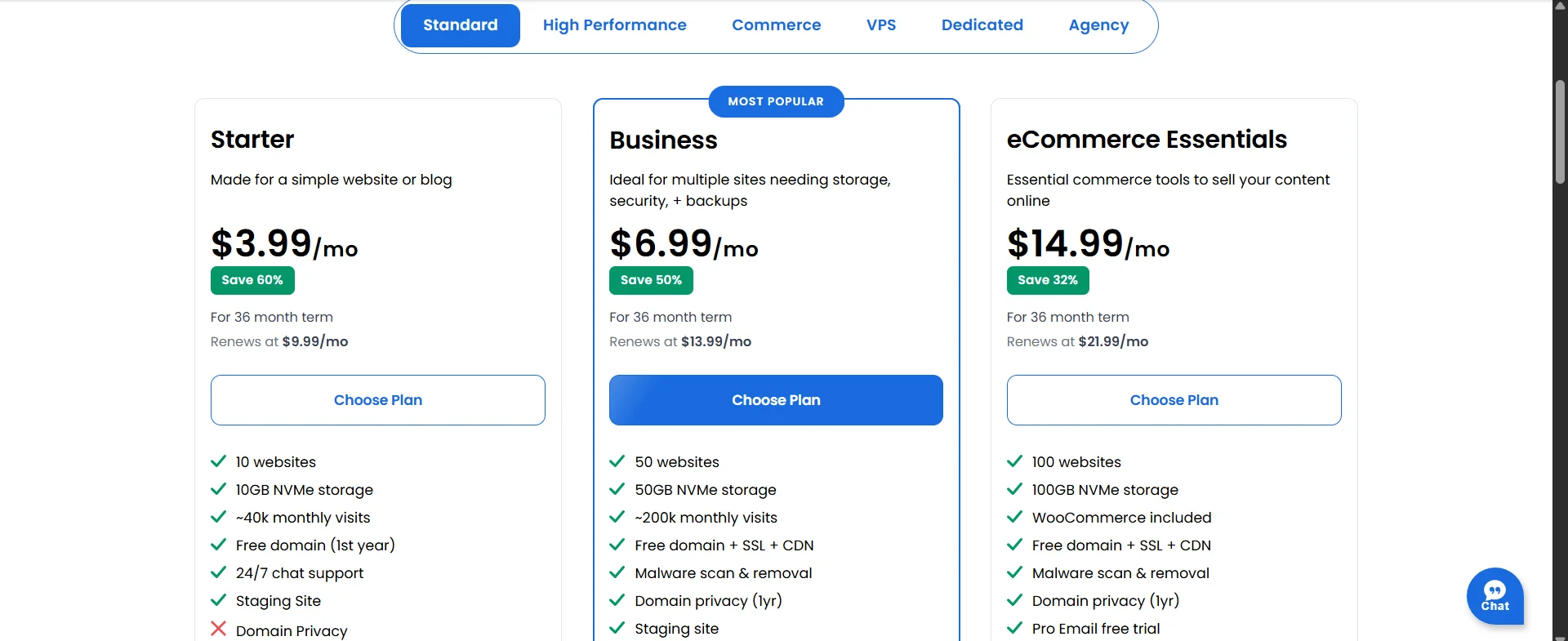
Bluehost’s current U.S. shared hosting pricing lists its Starter plan at $3.99/month on a 36-month term, renewing at $9.99/month, with 10 websites, 10 GB NVMe storage, a free domain for the first year, free CDN and a 30-day money-back guarantee. Business is $6.99/month (renews at $13.99/month) with up to 50 websites and 50 GB NVMe storage. Bluehost also offers higher eCommerce plans.
For Indian customers, pricing is different: Bluehost currently lists Starter at ₹199/month on a 36-month term, renewing at ₹349/month, while Business is ₹279/month and renews at ₹529/month. Because regional prices differ, every comparison on this page uses U.S. pricing.
Prefer more website slots and a lower renewal?
See Bluehost Plans →Hostinger vs Bluehost: Renewal Prices
| Hostinger | Bluehost | |
|---|---|---|
| Introductory price | $2.99 | $3.99 |
| Renewal | $10.99 | $9.99 |
| Initial commitment | 48 months | 36 months |
| Approx. price increase | ~3.7× | ~2.5× |
| Paid upfront for the first term | $143.52 (4 years) | $143.64 (3 years) |
| Yearly cost after renewal | $131.88/year | $119.88/year |
Hostinger has the lower introductory price. Bluehost currently has the lower renewal price on these entry plans. That’s exactly why choosing based only on the advertised monthly price can give you the wrong picture — if you’re keeping your website for several years, calculate initial term + renewal cost + domain renewal + optional add-ons rather than simply comparing the biggest discount.
On the entry plans, both hosts ask for roughly the same amount upfront (about $144), but Hostinger’s covers four years and Bluehost’s covers three. After the first term ends, Bluehost Starter costs about $12 a year less than Hostinger Premium.
Sources: prices on this page were read from Hostinger’s official web hosting page and Bluehost’s official shared hosting page in September 2026 (U.S. pricing, before tax). Hosting prices change often, so confirm the final figure at checkout.
Hostinger vs Bluehost: Features
Now let’s move beyond price.
Number of Websites
Hostinger Premium currently supports 3 websites. Bluehost Starter currently supports 10 websites. So if you plan to host several small websites under one account, Bluehost’s entry plan gives you more website slots — but storage runs the other way (Hostinger: 20 GB, Bluehost: 10 GB).
Storage
Hostinger Premium currently provides 20 GB SSD storage; Bluehost Starter provides 10 GB NVMe storage. NVMe is a newer storage technology, but storage technology alone doesn’t tell you how quickly your website will load — your theme, plugins, images, caching, CDN, database and PHP configuration matter more. Don’t choose a host simply because one table says “NVMe.”
Free Domain
Both Hostinger and Bluehost offer a free domain for the first year on eligible plans. Free for year one does not mean free forever — after the promotional period you’ll normally pay the domain’s renewal price separately. If you want to compare domain costs separately, Etemora already has a useful tool: Calculate Your Domain Renewal Cost → and you can Compare the Best Domain Registrars →.
SSL
SSL is no longer something you should expect to pay extra for on a normal website. Both providers currently offer SSL on their hosting products, although the exact security package varies by plan and market. For a normal WordPress site, HTTPS should be considered essential.
Backups
Hostinger’s plans vary by tier — Premium gets weekly backups, higher plans get daily backups and more restore capability. Bluehost’s current plans also include backups, with frequency depending on the plan. Don’t just ask “does this host include backups?” — ask how frequently they’re taken, how long they’re retained, and how easy restoration is.
Website Migration
Both companies provide migration options, which matters if you’re already running a site elsewhere. A migration can involve website files, database, WordPress configuration, domain, DNS, email, SSL and redirects — so check whether the specific migration service is included with your plan.
CDN
Both Hostinger and Bluehost currently include CDN functionality on their relevant shared plans, which can help deliver images, CSS and JavaScript from locations closer to visitors. But CDN doesn’t automatically mean a fast website — a badly optimized WordPress site can still be slow even with a CDN.
Hostinger vs Bluehost for WordPress
Both hosts support WordPress. Bluehost has historically positioned itself very strongly around WordPress, continuing to emphasize installation, managed updates and WordPress-oriented tools. Hostinger also has extensive WordPress hosting alongside its website builder and other tools.
For a beginner, both can handle a normal WordPress website. The more important question is what kind of WordPress website you’re building:
Personal blog or affiliate website: either can work — you’ll care more about page speed, caching, image optimization, CDN, backups and security than the host’s logo.
Small business website: either can work.
Large WooCommerce store: this is where you should start looking beyond entry-level shared hosting toward cloud or managed hosting.
Comparing WordPress-specific hosting options?
Compare the Best WordPress Hosting →Hostinger vs Bluehost: Website Builder
Both providers have moved beyond traditional hosting. Hostinger includes an AI website builder and AI-powered tools on its current hosting platform. Bluehost also currently offers AI site creation tools with its shared hosting plans. That means a beginner can potentially choose hosting, create a website, add content, connect a domain and publish without separately buying a website builder. If you’re comparing dedicated website builders on their own, that’s a different decision — see Best Website Builders in 2026 →.
Hostinger vs Bluehost: Performance
This is one section where we need to be careful. A hosting company can publish impressive infrastructure specifications, but that doesn’t automatically mean your website will be faster — performance depends on server resources, caching, CDN, WordPress configuration, theme, plugins, images, database, traffic and geographic location.
Hostinger currently advertises a 99.9% uptime guarantee and multiple data centers, while Bluehost advertises a 99.99% uptime SLA on its current India shared plans. Those are provider claims, not an independent Etemora benchmark.
Important note: we have not independently run identical production websites on both providers, so this comparison does not pretend to provide our own laboratory speed scores. That’s better than putting a made-up speed rating into a table.
Hostinger vs Bluehost: Security
Hostinger’s comparison page lists a malware scanner, free SSL, backups and CDN as part of its current offering. Bluehost’s current plans list SSL, malware scanning/removal on relevant tiers, backups and CDN, with more advanced features at higher levels. Hosting security isn’t a substitute for WordPress security — you should still use strong passwords, two-factor authentication, trusted plugins, regular updates, backups and a security plugin where appropriate.
Hostinger vs Bluehost: Customer Support
Both providers advertise 24/7 support. Hostinger says its support is available in 8+ languages with an average response time under three minutes on its current comparison page. Bluehost currently advertises 24/7 support, with live chat and phone support availability varying by plan and region — its current India Starter plan, for example, lists 24/7 chat but no phone support, while Business includes phone support. Don’t simply assume both have 24/7 support — check what type of support you actually get.
Which Is Easier for Beginners?
Both are designed to reduce the technical work involved in launching a website. Bluehost has a strong WordPress-first positioning and beginner-oriented setup. Hostinger combines hosting, domains, website building and AI tools inside its platform. For someone launching their first WordPress website, either can provide a relatively straightforward starting point — the better fit depends on whether you value more website slots, more storage, a lower initial price, a lower renewal, AI website-building tools, WordPress workflow, or specific support options, rather than simply choosing based on brand familiarity.
Hostinger vs Bluehost for Affiliate Websites
This is particularly relevant if you’re building niche websites, affiliate websites, blogs, review sites, comparison sites or SEO sites. For a small affiliate website, you generally don’t need expensive managed WordPress hosting from day one — you need a host that can comfortably handle WordPress, SEO plugins, affiliate links, comparison tables, images, analytics, caching, backups and security. Both Hostinger and Bluehost can fit that use case. If you’re building an affiliate site specifically, also compare your domain and hosting costs together.
Useful Etemora guides: Best Web Hosting Services in 2026 → · Best Domain Registrars in 2026 → · What Is Web Hosting and How Does It Work? →
Hostinger vs Bluehost: Pros and Cons
Hostinger
Pros: lower introductory price on the compared plans, 20 GB storage on Premium, 3 websites on Premium, AI website tools, CDN included, free domain on eligible plans, weekly/daily backup options depending on plan, clear upgrade path into cloud hosting, 24/7 support.
Cons: requires a 48-month commitment for the headline price, renewal rises substantially, entry plan isn’t designed for heavy-traffic sites, some features require higher tiers.
Bluehost
Pros: 10 websites on the current Starter plan, 10 GB NVMe storage, WordPress-oriented setup, free first-year domain, CDN included, AI website creation tools, 30-day money-back guarantee, 24/7 support, lower current renewal price than Hostinger’s compared entry plan.
Cons: higher introductory price, still requires a three-year term for the headline price, storage is lower on the entry plan, advanced features require higher tiers, pricing varies considerably by region.
Which Plan Should You Choose?
Instead of asking which company is universally better, start with the website you’re building.
Choose an entry shared plan if you’re building a personal blog, portfolio, small business site, affiliate site or simple WordPress website.
Consider a higher shared plan if you need multiple websites, more storage, more databases/resources, more backups or ecommerce functionality.
Consider cloud hosting if your website is growing quickly, receiving substantially more traffic, resource intensive, running a busy store, or hosting multiple high-traffic projects.
Hostinger currently offers a Cloud Startup tier alongside its shared plans, while Bluehost also offers higher-performance and cloud-oriented products.
Hostinger vs Bluehost vs Other Hosting Providers
The decision doesn’t have to stop with these two. Etemora’s broader hosting comparison currently covers 10 providers, including Hostinger, Bluehost, SiteGround, DreamHost, Namecheap, HostGator, WP Engine, Cloudways, Kinsta and InMotion. So if neither looks like the right fit, don’t force the decision.
Compare 10 Web Hosting Services →
And if you’re specifically considering managed WordPress hosting: Hostinger vs WP Engine →
Which One Should You Buy?
The simplest way to make the decision is to ignore the discount percentages for a minute and ask yourself a few direct questions.
Do I need the lowest possible starting price? Look at Hostinger.
Do I need more website slots on the entry plan? Bluehost currently gives you more.
Do I care about the lower renewal price between these two entry plans? Bluehost currently renews at $9.99 versus Hostinger’s $10.99.
Do I want more storage on the compared entry plan? Hostinger currently provides 20 GB versus Bluehost’s 10 GB.
Am I building a normal WordPress website? Either can work.
Am I building a serious ecommerce or high-traffic website? Don’t stop at shared-hosting comparisons — look at cloud or managed hosting.
Not sure which host fits your project?
Compare All Web Hosting Services →Hostinger vs Bluehost: Final Verdict
Hostinger and Bluehost are close enough that the decision should come down to the specific plan and your website requirements, not a generic claim that one company is always better.
Hostinger makes more sense when you want: lower introductory pricing, more storage on the compared plan, AI website tools, a broader hosting upgrade path, a low-cost starting point.
Bluehost makes more sense when you want: more website slots on the entry plan, WordPress-focused setup, a lower renewal price between these two compared plans, beginner-oriented website tools, an established WordPress hosting ecosystem.
And there’s one thing both have in common: don’t buy based on the promotional price alone. Look at the amount you’ll pay today, how long you’re committing for, what happens at renewal, which features disappear at the next tier, and what your website will need six months from now. That’s a much better way to choose hosting than simply clicking whichever “$X.XX/month” number looks smaller.
How We Compared Hostinger and Bluehost
This is a research-based comparison, not a claim of identical hands-on benchmark testing. We checked the providers’ current pricing and feature pages in September 2026 and compared introductory pricing, required billing term, renewal pricing, website limits, storage, backups, SSL, CDN, security, WordPress support, AI website tools, migration, support and money-back guarantees. Where pricing differs by country, we identify the region rather than pretending one price applies worldwide. Hosting prices and included features can change, so check the final checkout price and renewal rate before purchasing.
Frequently Asked Questions
Is Hostinger better than Bluehost?
There isn’t one answer for every website. Hostinger currently offers a lower introductory price and more storage on the compared entry plans, while Bluehost currently offers more websites and a lower renewal price on its entry plan.
Is Bluehost cheaper than Hostinger?
Not initially on the U.S. plans compared here. Hostinger starts at $2.99/month versus Bluehost at $3.99/month, but Bluehost currently renews at $9.99/month compared with Hostinger’s $10.99/month.
Is Hostinger good for WordPress?
Yes. Hostinger provides WordPress hosting and WordPress-focused tools alongside its general hosting products.
Is Bluehost good for beginners?
Bluehost specifically positions its hosting around beginner-friendly website creation and WordPress setup, and its current plans include AI website creation tools and managed WordPress updates.
Does Hostinger offer a free domain?
Yes, eligible Hostinger plans include a free domain for the first year.
Does Bluehost offer a free domain?
Yes, eligible Bluehost plans include a free domain for the first year.
Do Hostinger and Bluehost include SSL?
Yes. Both currently offer SSL on their hosting plans, although exact security features can vary by plan and region.
Can I migrate from Bluehost to Hostinger?
Yes. WordPress websites can be migrated between the two platforms, subject to the site’s configuration and the destination plan’s requirements. The same applies in reverse — before migrating, take a full backup and verify files, database, email, DNS, SSL, redirects and WordPress URLs.
Which is better for an affiliate website?
Both can support a normal affiliate website. Compare the resources, renewal price, backups, security, CDN and upgrade path rather than choosing purely on the promotional price.
Affiliate Disclosure: Some links on this page may be affiliate links. If you purchase through an eligible link, Etemora may earn a commission at no additional cost to you. Our editorial recommendations are not determined solely by commission. Learn more →
Related articles you may like
 Web HostingHostinger vs WordPress.com: 2026 Honest Comparison
 Web HostingHow to Buy a Domain Name in 2026: 8 Simple Steps
 Web HostingLargest Domain Registrars in 2026 (Ranked by .com Domains)
 SecurityMost Secure Domain Registrars in 2026: 2FA, Locks and Privacy Compared
 Web HostingHow to Transfer a Domain to Another Registrar (Step by Step)
 Web HostingWhy Domain Renewal Prices Go Up (and 7 Ways to Pay Less)