
What Is Affiliate Marketing? Complete 2026 Beginner Guide
 By M. Zaid
- Updated October 16, 2026
- 21 min read

What is affiliate marketing, and can a beginner use it to earn money online? Affiliate marketing is a business model in which you recommend a company’s products or services and may earn a commission when someone makes a qualifying purchase or completes another required action through your referral. You might promote products through a website, blog, YouTube channel, email newsletter or social media account.
However, adding links does not automatically generate income. You need an audience, useful content, relevant offers and a clear understanding of each program’s rules. This guide explains what is affiliate marketing in practice: how it works, how commissions are earned, where to find programs and how to build a realistic starting plan.
Quick answer: What is affiliate marketing? It is a performance-based arrangement in which a business rewards a publisher or creator for qualifying sales, leads or other actions generated through tracked referrals. Beginners can start with a website or content channel, join a suitable affiliate program, publish helpful content and use approved links. Earnings are not guaranteed and depend on traffic, audience trust, conversions, commission terms and other factors.
Looking at other online income models too?
See Practical Ways to Make Money Online →What Is Affiliate Marketing and How Does It Work?
Affiliate marketing connects a business that wants customers with a publisher who can introduce relevant products or services to potential buyers. The publisher receives a special tracking link, or another approved referral method, from the affiliate program.
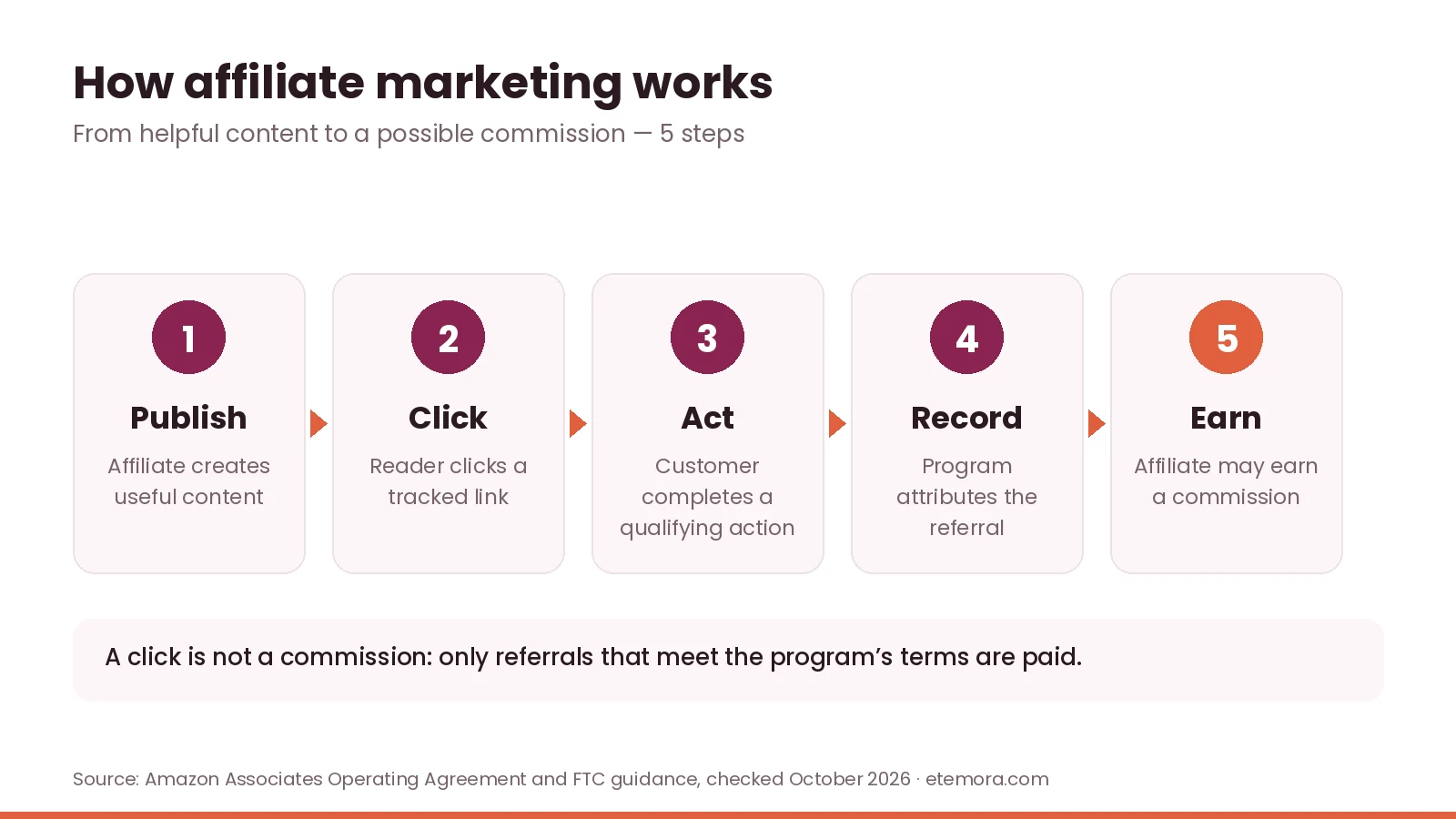
The process generally has five steps:
- Join a program. Apply to a company’s affiliate program or an affiliate network and review its eligibility requirements.
- Choose a relevant offer. Select a product or service that matches your audience’s needs.
- Publish helpful content. Create an honest tutorial, comparison, product guide or other useful resource.
- Share a tracked link. Add the program’s approved link where it makes sense for readers.
- Earn a commission if eligible. If a visitor completes a qualifying action and the referral meets the program’s terms, the program may credit you with a commission.
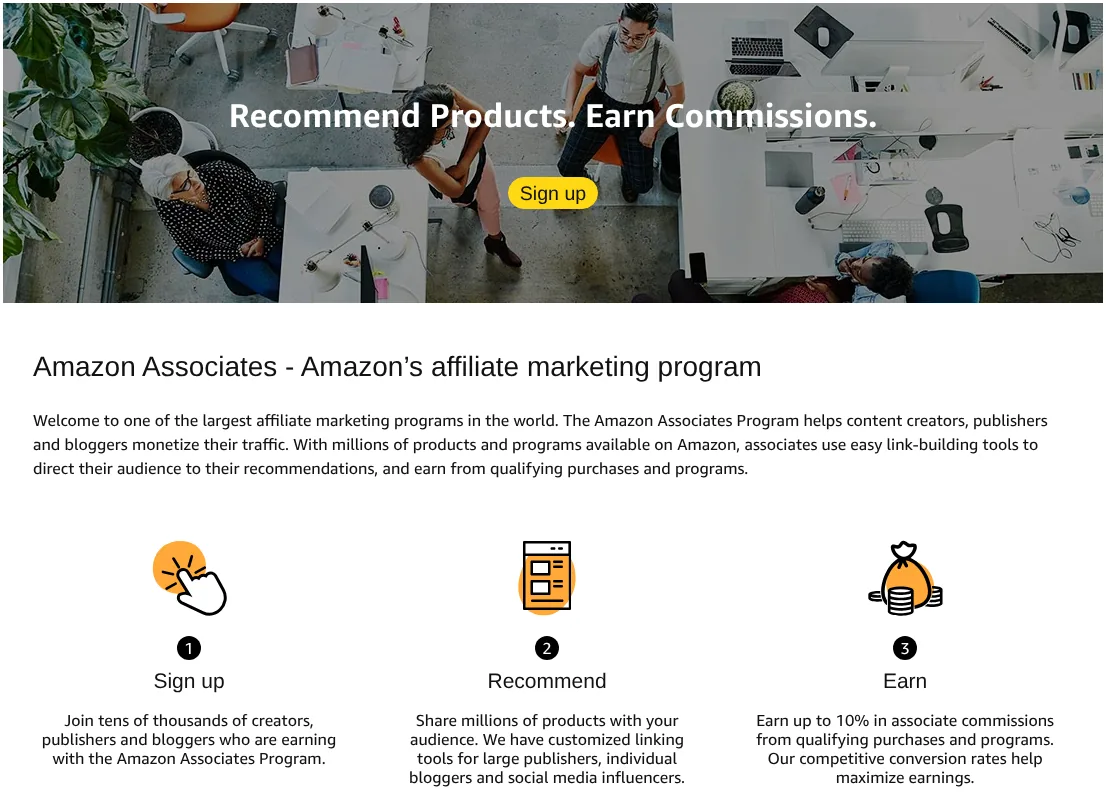
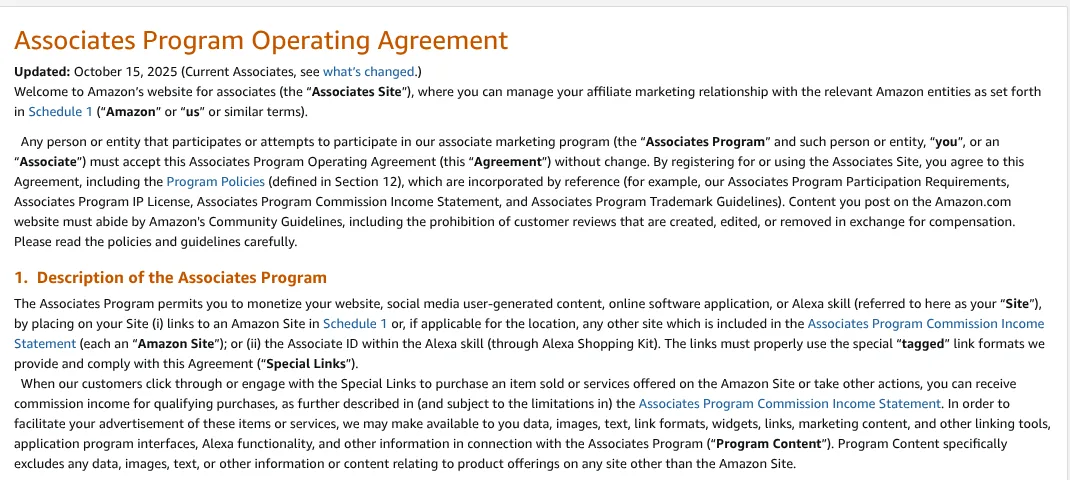
Amazon’s Associates program is a well-known example. Its Associates Program Operating Agreement lets participants place specially “tagged” links (Amazon calls them Special Links) and receive commission income for qualifying purchases, subject to the limits in its Commission Income Statement. Amazon’s program page says associates can earn up to 10% from qualifying purchases and programs, and that rates differ by product category.
Eligibility, exclusions, tracking rules and commission rates always depend on the program agreement, so read it before you rely on any number.
A Simple Affiliate Marketing Example
The easiest way to see what is affiliate marketing in action is a simple example. Imagine you publish an article comparing three web hosting services. A reader follows a link to one provider and buys an eligible hosting plan. If the program tracks the referral and the sale meets its conditions, you may receive a commission.
Here is a hypothetical illustration:
- Qualifying purchase value: $100
- Hypothetical commission rate: 10%
- Potential commission: $10
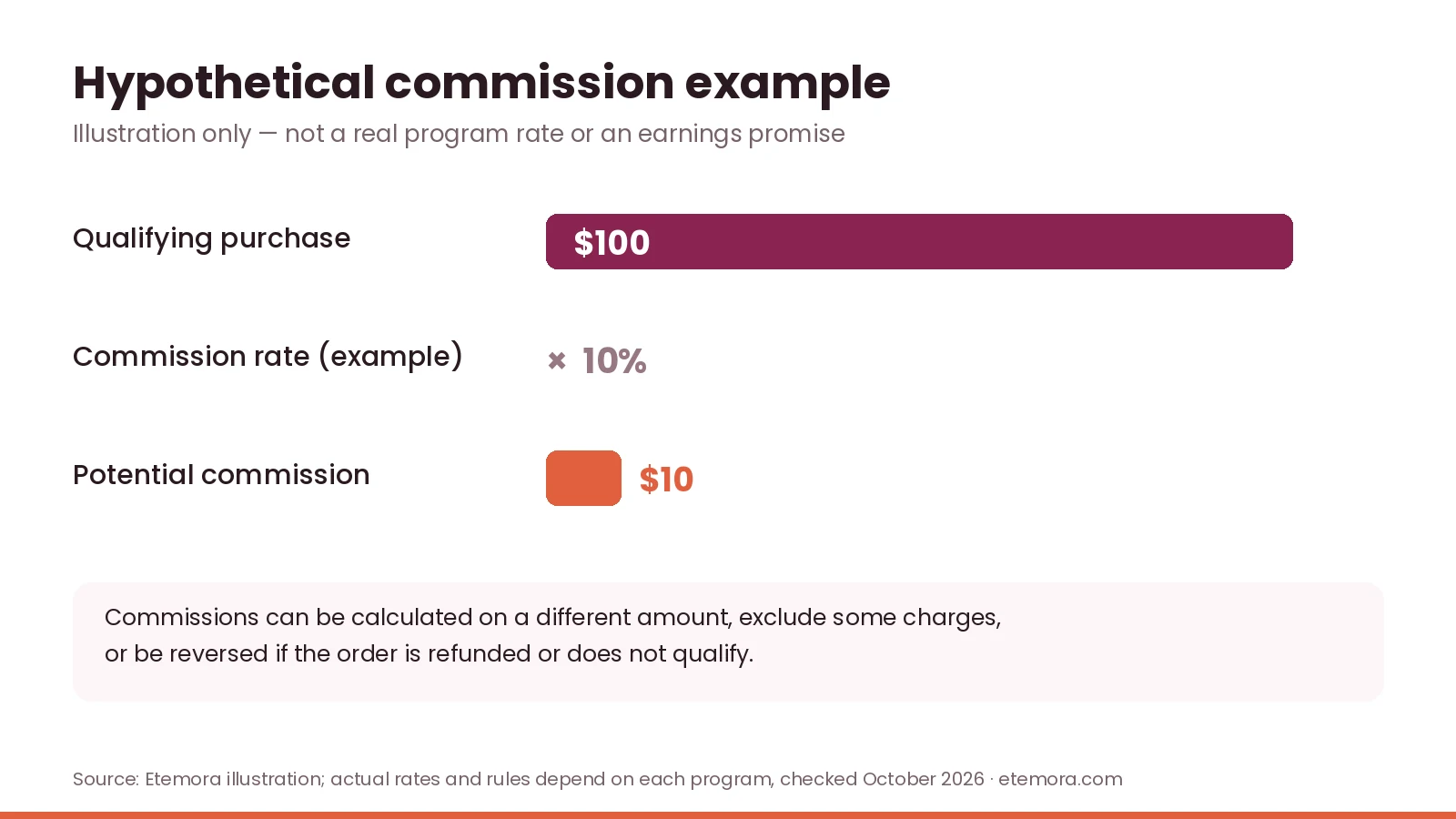
These figures are an example, not a real program’s rate or a promise of earnings. Actual commissions may be calculated on a different amount, exclude certain charges, or be reversed when a purchase is refunded or does not qualify.
Who Are the Main Players in Affiliate Marketing?
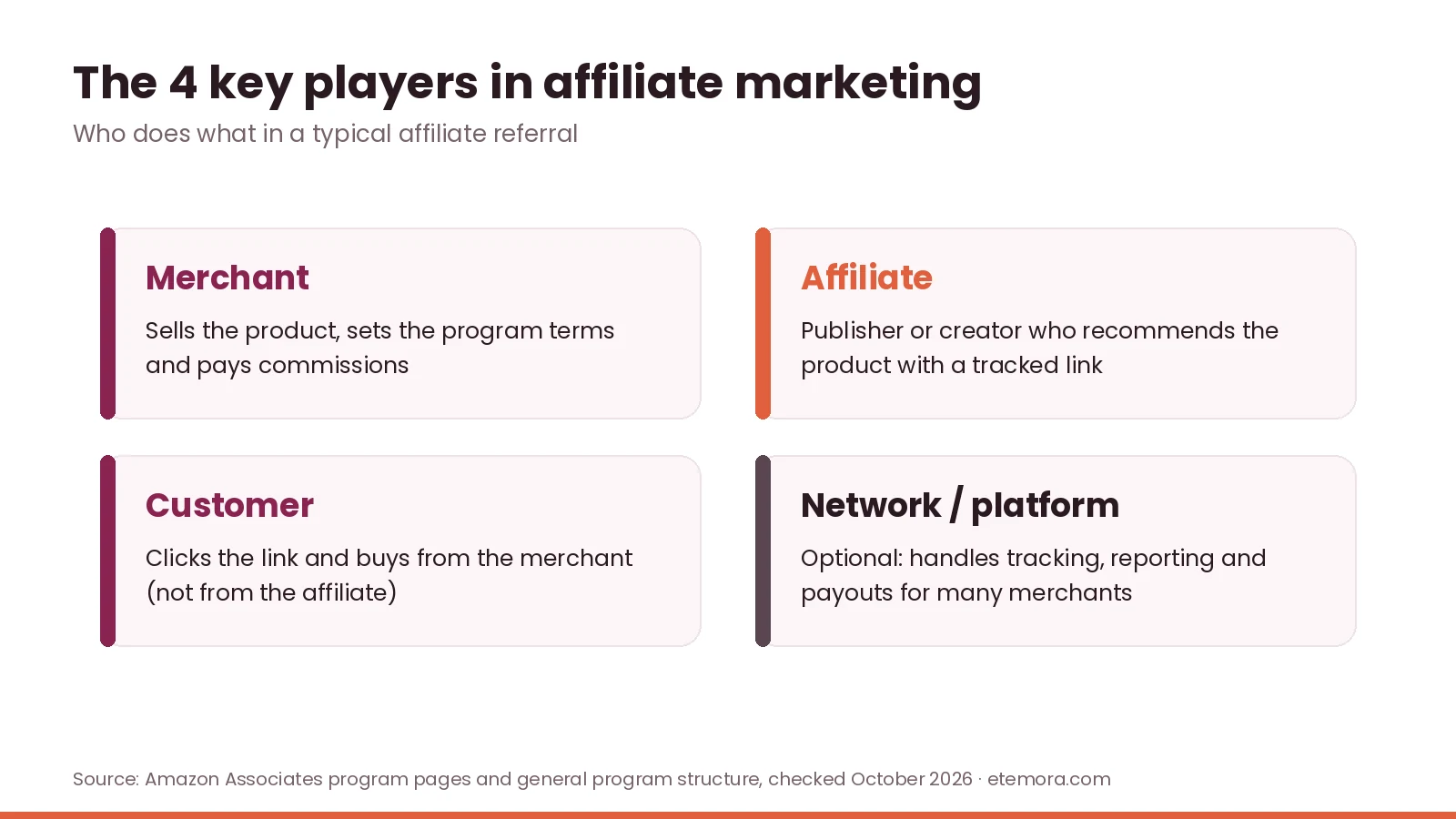
To understand what is affiliate marketing, it helps to know who is involved. Four participants commonly appear in the process, although some programs combine roles or operate without a separate network.
1. The merchant
The merchant is the business selling the product or service. It sets the program’s terms, defines qualifying actions, determines commission rules and handles the customer transaction. Examples include a web hosting company, software provider, online retailer or educational platform.
2. The affiliate
The affiliate is the publisher, creator or marketer who refers potential customers. Affiliates may run a blog, comparison website, newsletter, YouTube channel or social media account.
A useful affiliate does more than insert links. They help people understand a product, compare options, answer questions or decide whether a service fits their needs.
3. The customer
The customer is the person who clicks a referral link and may purchase a product or complete another qualifying action. The customer generally buys from the merchant, not from the affiliate.
4. The affiliate network or tracking platform
Some businesses manage affiliate programs directly. Others use an affiliate network or tracking platform to manage applications, referral attribution, reporting and payments. CJ, for example, describes itself as a partnership-based performance marketing platform for brands, publishers and creators.

A network can make it easier to find several programs in one place, but joining a network does not mean every merchant will approve your application.
What Are the Different Types of Affiliate Commissions?
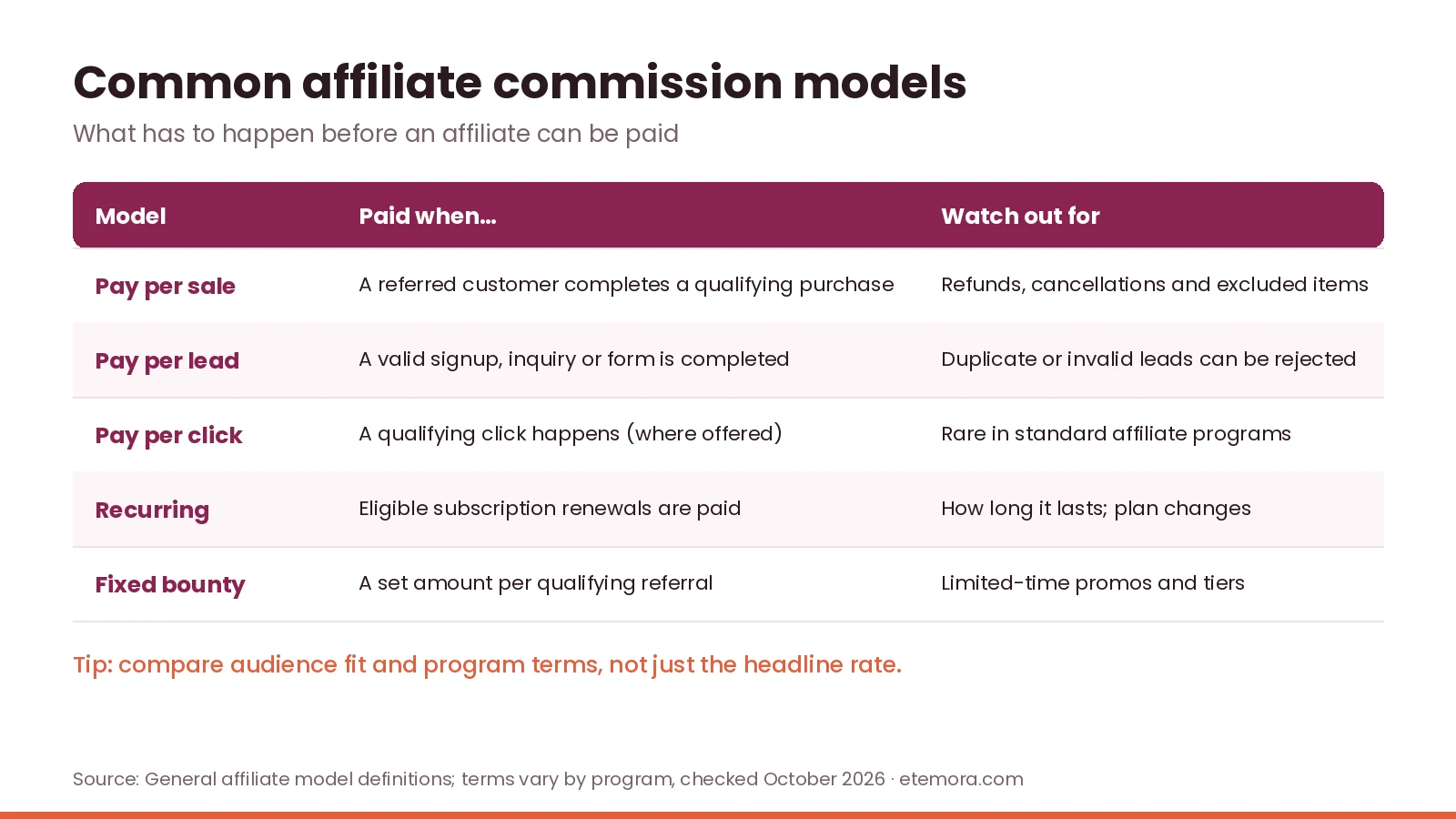
Any answer to what is affiliate marketing has to cover how affiliates are paid. The commission model determines what must happen before an affiliate can earn money. Always read the program’s terms, because similar labels can have different conditions.
Pay per sale
The affiliate earns a commission when a referred customer completes a qualifying purchase. The payment might be a percentage of eligible revenue or a fixed amount. This model is common in retail, software, hosting and other product categories. A sale may not qualify if it is cancelled, refunded, excluded by the agreement or attributed to another referral.
Pay per lead
The affiliate may earn a fee when a referred visitor completes an eligible action, such as submitting a valid inquiry or registering for a qualifying service. A lead does not necessarily mean a completed sale, and programs can reject duplicate or invalid leads.
Pay per click
In a pay-per-click arrangement, the affiliate may earn money for qualifying clicks rather than purchases. This is different from conventional affiliate programs that pay only when a sale or lead occurs. Many programs track clicks for reporting but pay commissions only for specific completed actions.
Recurring commissions
Some subscription businesses offer commissions on eligible recurring payments, while others pay only for the initial sale. Check how long commissions can continue, whether renewals qualify, and what happens if the customer cancels or changes plans.
Fixed bounties or tiered rates
A program may pay a fixed amount for a qualifying referral or use different rates for different products, customer types or performance levels. Special promotions can also change the amount for a limited period.
Important: do not choose a program based only on its advertised commission. A high rate is not helpful if the offer is irrelevant to your audience or the terms make qualifying referrals unlikely.
How Do Affiliate Links and Tracking Work?
Tracking is the technical core of what is affiliate marketing. Affiliate links contain a unique identifier or other tracking information that helps a program connect a referral with an affiliate. When a visitor clicks a link, the program may record the referral using cookies or other permitted tracking methods.
The program then applies its attribution rules to decide whether a later purchase or action qualifies. Those rules can include an attribution window, exclusions and conditions involving other marketing channels. Never assume every program uses the same tracking period.
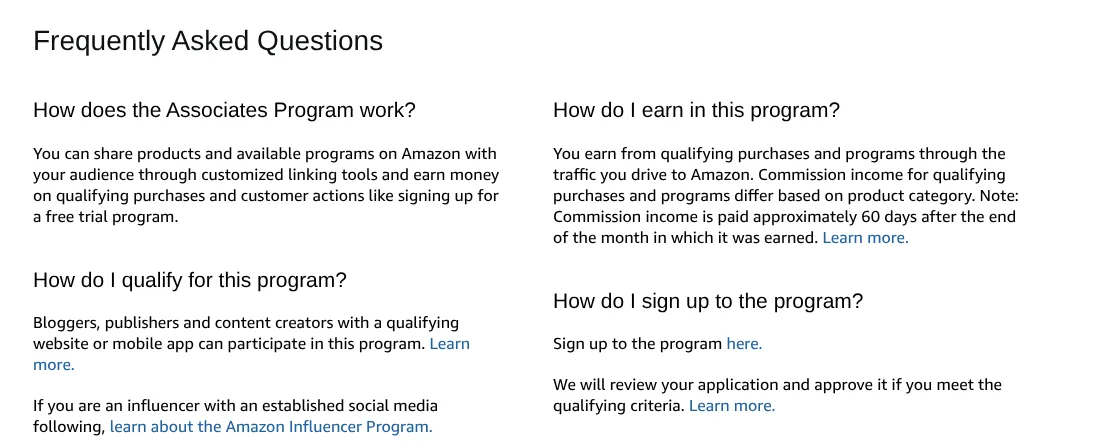
Payment timing varies too. Amazon’s Associates FAQ, for instance, says commission income is paid approximately 60 days after the end of the month in which it was earned.
Tracking can also fail or become less reliable because of browser settings, device changes, privacy restrictions, consent choices or other technical factors. A click is not the same as a confirmed commission. The practical lesson: use the program’s approved links, check reporting regularly and follow its rules for link placement and promotion.
Do Affiliate Links Affect SEO?
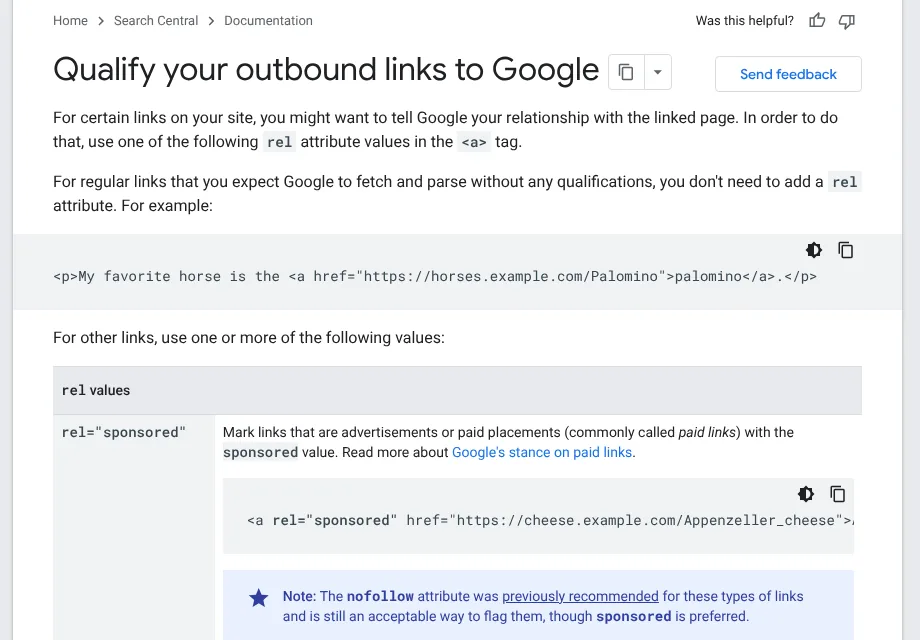
Understanding what is affiliate marketing also means knowing how search engines treat these links. Affiliate links can be used on websites, but they should be marked correctly. Google’s guide to qualifying outbound links says to mark advertisements or paid placements with rel="sponsored". The nofollow value is still an acceptable way to flag them, though sponsored is preferred.
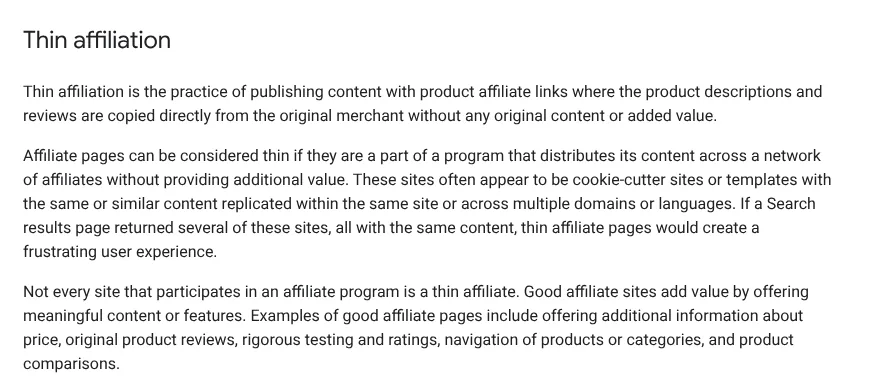
Affiliate links alone do not make a page useful. Google’s spam policies describe “thin affiliation” as pages with affiliate links where product descriptions and reviews are copied from the merchant without original content or added value. The same policy notes that not every affiliate site is thin: good affiliate pages add value through things like price information, original reviews, navigation of products and product comparisons.
For more help with organic traffic, compare SEO tools for research and organic growth, or start with our beginner explainer on how SEO works.
What Is Affiliate Marketing for Beginners? How to Start in 6 Steps
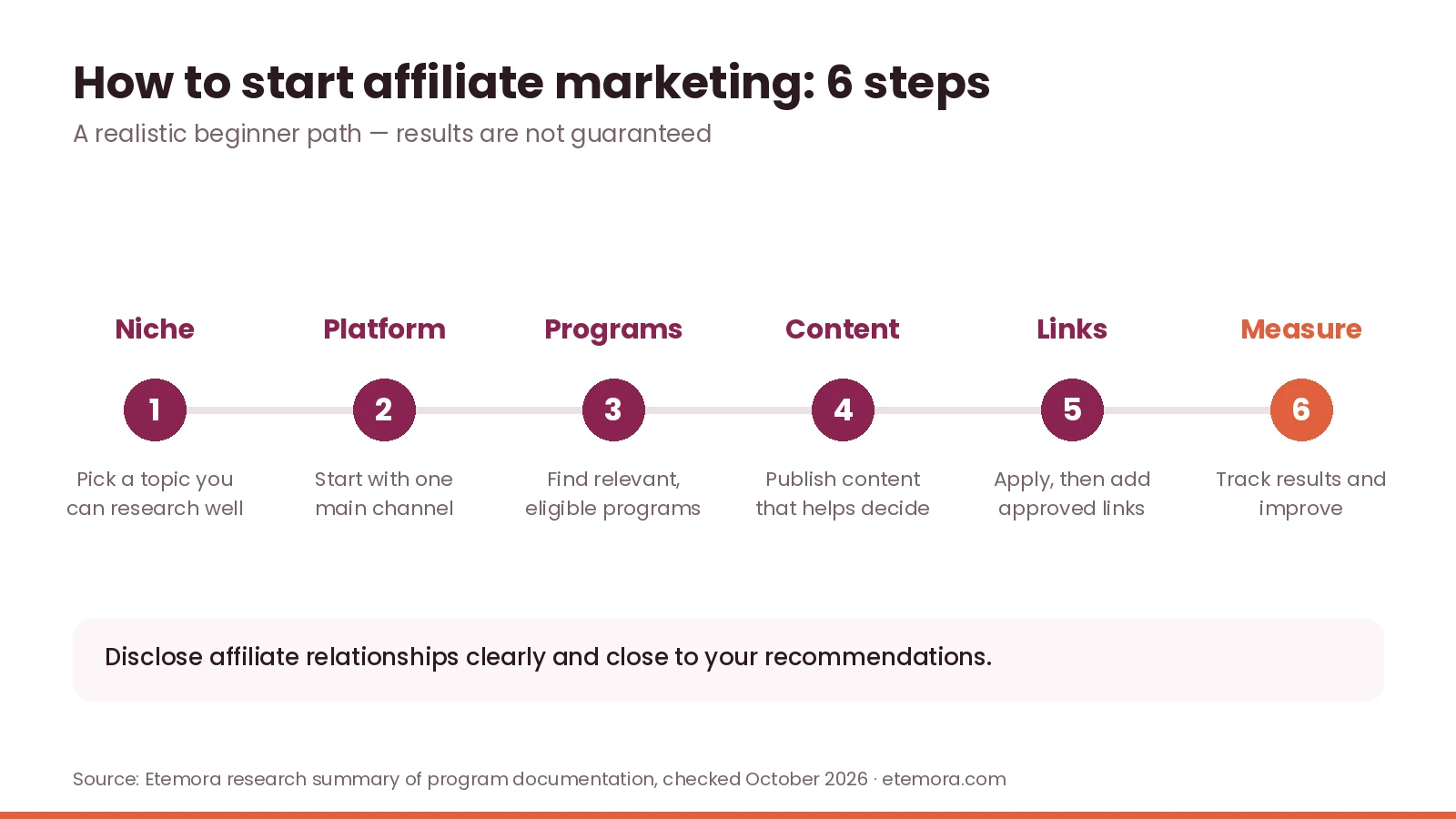
Knowing what is affiliate marketing in theory is only the first step. You do not need to build a large company before exploring it. You do need a clear topic, a suitable audience and a plan for publishing useful content consistently.
Step 1: Choose a specific niche
A niche is the subject area you intend to serve, such as website hosting, productivity software, home office equipment or outdoor gear. Choose a topic you can research carefully and explain to a defined audience. Ask three questions:
- Do people in this niche research products before buying?
- Are there legitimate programs for products that fit their needs?
- Can you create useful content that is more than a collection of sales links?
Avoid choosing a niche only because someone claims it pays high commissions. You need to understand the reader’s problem well enough to make credible recommendations.
Step 2: Choose a platform
Your platform is where people discover your content. Common options include:
- A website or blog: useful for detailed guides, comparisons, tutorials and search traffic.
- YouTube: useful for visual demonstrations, explanations and product walkthroughs.
- Social media: useful for short educational posts and community engagement.
- An email newsletter: useful for building an audience that chooses to receive your updates.
Beginners may find it easier to start with one primary platform. If you choose a website, our guide to understanding web hosting explains what you need to get it online. Review the platform’s policies and the affiliate program’s rules before adding links.
Step 3: Find relevant affiliate programs
Search the official websites of businesses in your niche for pages labelled affiliate program, partner program or publisher program. Affiliate networks can also help you discover participating merchants. Before applying, check:
- Whether your website or channel is eligible.
- Whether the program accepts publishers from your country.
- How commissions are calculated.
- Which products, actions and traffic sources qualify.
- How long referrals can be attributed.
- The payment threshold, schedule and available methods.
- Whether the program restricts email, paid search, coupon or social media promotion.
Do not assume approval is automatic. Amazon, for example, says it reviews applications and approves them if they meet its qualifying criteria.
Step 4: Create content that helps people decide
Your content should answer a real question before it asks readers to buy anything. Useful formats include beginner’s guides, comparisons that describe important differences, tutorials that solve a problem, buying guides that match products to different needs, and reviews based on clearly identified evidence and limitations.
For example, an article about choosing web hosting could explain storage, backups, renewal pricing, support and the difference between shared and managed hosting. Relevant links can then help readers explore providers that meet their requirements. Good AI tools for content planning and research can speed up outlining, but the facts and judgement still need to be yours.
Step 5: Apply and add approved links
Once you have selected a program, follow its application process. If accepted, create links with its approved tools and place them in relevant sections of your content. A link should help the reader take the next step, not interrupt the explanation.
Keep a record of which pages contain affiliate links and which programs they use. That makes it easier to update links when products, terms or destinations change.
Step 6: Measure performance and improve
Review the metrics in your program dashboard. Depending on the program, these may include clicks, orders, qualifying actions, conversion rates, commissions and reversed transactions.
If a page attracts visitors but few clicks, the recommendations may be poorly matched to the topic or the next step may be unclear. If people click but commissions rarely qualify, review the offer, audience fit and program conditions. These are diagnostic possibilities, not guaranteed explanations. Change one element at a time and judge progress over a meaningful period. The marketing tools for affiliate content and campaigns we compared can help with analytics and email.
Building your content stack?
Compare the Best Marketing Tools →How to Choose an Affiliate Marketing Program
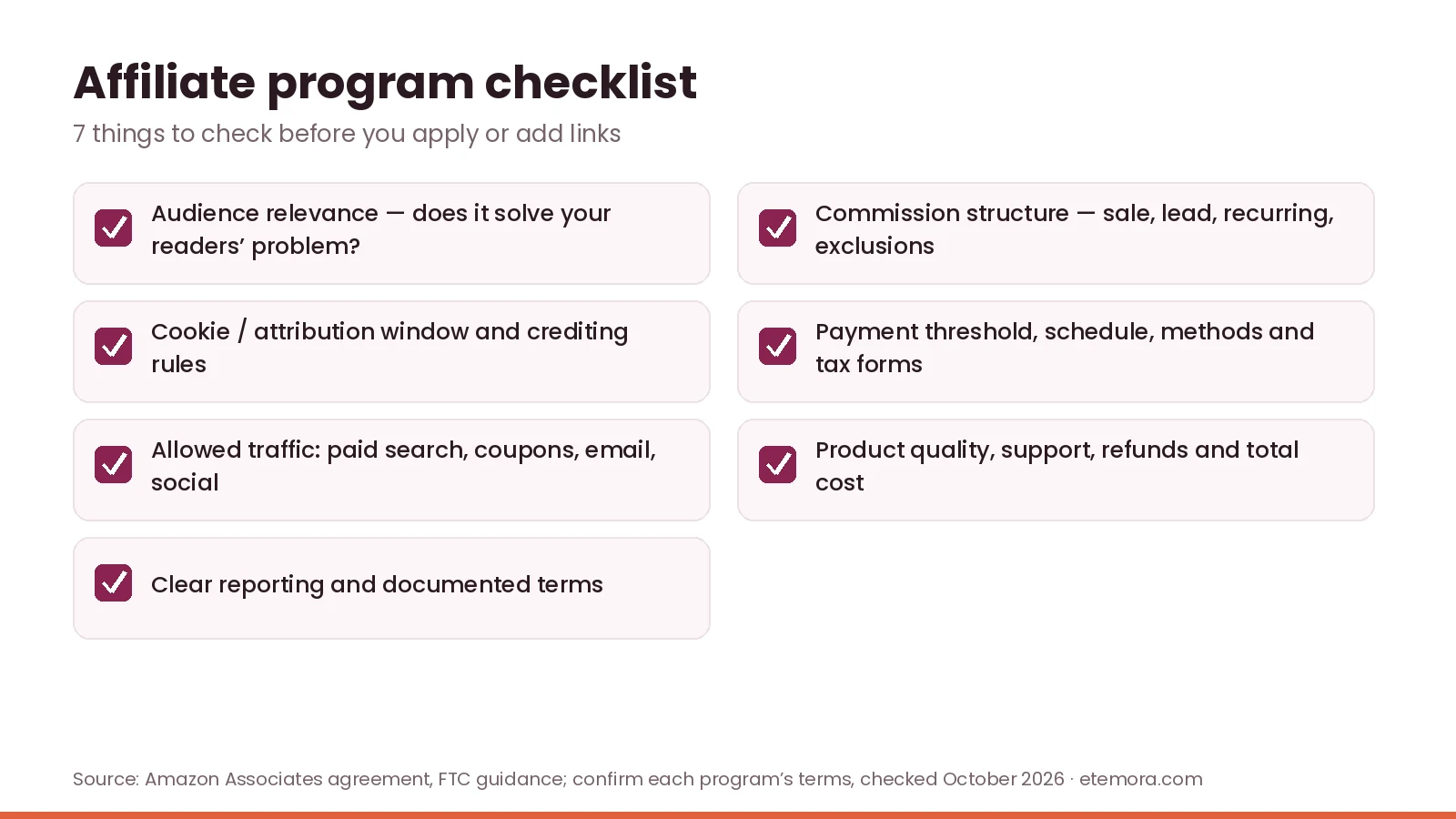
Once you know what is affiliate marketing, the next decision is which program to join. The right affiliate program fits your audience, offers clear terms and provides a realistic way to earn from the content you can create. Use these seven factors to compare options.
1. Audience relevance
Choose products that solve problems your readers actually have. A hosting provider may be relevant to an audience building websites, while an unrelated fashion offer may not be. Visitors need a reason to consider the recommendation.
2. Commission structure
Understand whether the program pays per sale, lead or another qualifying action. Check the calculation, eligible products, exclusions and whether recurring payments qualify. Compare the likely fit of an offer with its commission rather than ranking programs by headline rates alone.
3. Cookie and attribution rules
Read how the program tracks referrals and assigns credit. Check the attribution window and whether other channels, later clicks or specific purchase types can affect eligibility.
4. Payment terms
Review the payment threshold, schedule, supported payment methods, currency and any tax documentation requirements. A commission shown in a dashboard may not be payable immediately.
5. Program restrictions
Check whether the merchant permits your platform and promotional methods. Some programs have specific rules for paid search, coupon sites, email, brand names or social media. Breaking them can put commissions or participation at risk.
6. Product quality and support
Research the actual product, its limitations, customer support, cancellation policies and total cost. A credible recommendation explains who benefits from a product and who may be better served by an alternative.
7. Reporting and reliability
Look for understandable reporting and clearly documented terms. Track clicks and qualifying actions, but remember that reported activity is not the same as confirmed, payable income.
Common Affiliate Marketing Mistakes to Avoid
Learning what is affiliate marketing takes an afternoon; doing it well takes longer, and beginners often make avoidable mistakes.
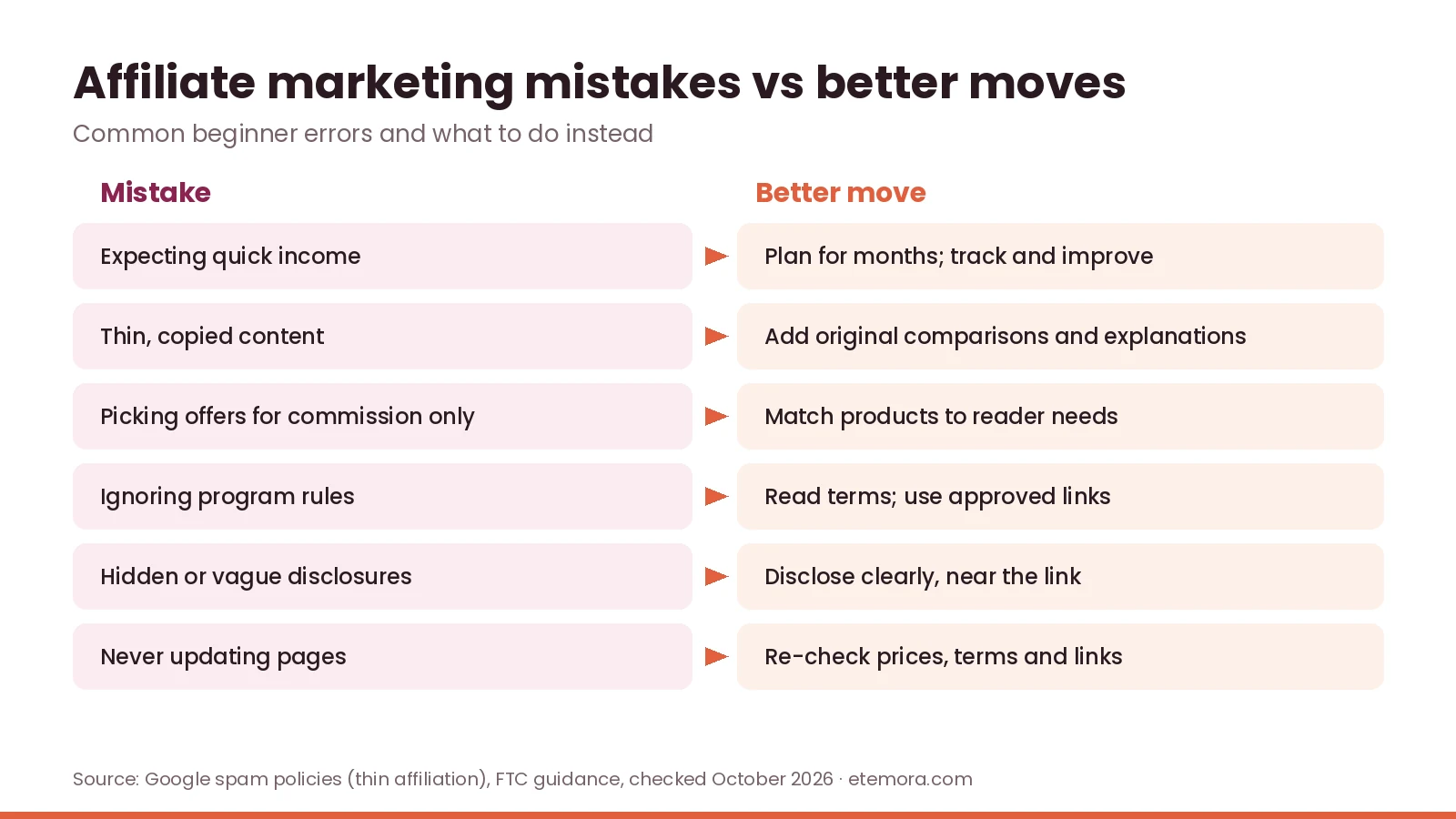
- Expecting quick income: traffic and sales may take time to develop, and some projects never become profitable.
- Publishing thin content: a page with little useful information gives readers few reasons to trust its recommendations.
- Choosing products for commission alone: an unsuitable offer can damage credibility and fail to meet readers’ needs.
- Ignoring program rules: unapproved promotion or incorrect links can lead to rejected referrals or account problems.
- Making unsupported claims: never invent product benefits, results, customer feedback or earnings figures.
- Forgetting maintenance: prices, features, program terms and links change.
- Relying on one traffic source: search rankings, platform policies and audience behaviour can change.
Do Affiliate Marketers Need to Disclose Affiliate Relationships?
Disclosure is part of what is affiliate marketing done responsibly. In the United States, the Federal Trade Commission’s Endorsement Guides FAQ says an affiliate marketer should disclose the relationship with the retailer clearly and conspicuously, so readers can decide how much weight to give the endorsement. It suggests wording like “I get commissions for purchases made through links in this post” and says the closer the disclosure is to the recommendation, the better.
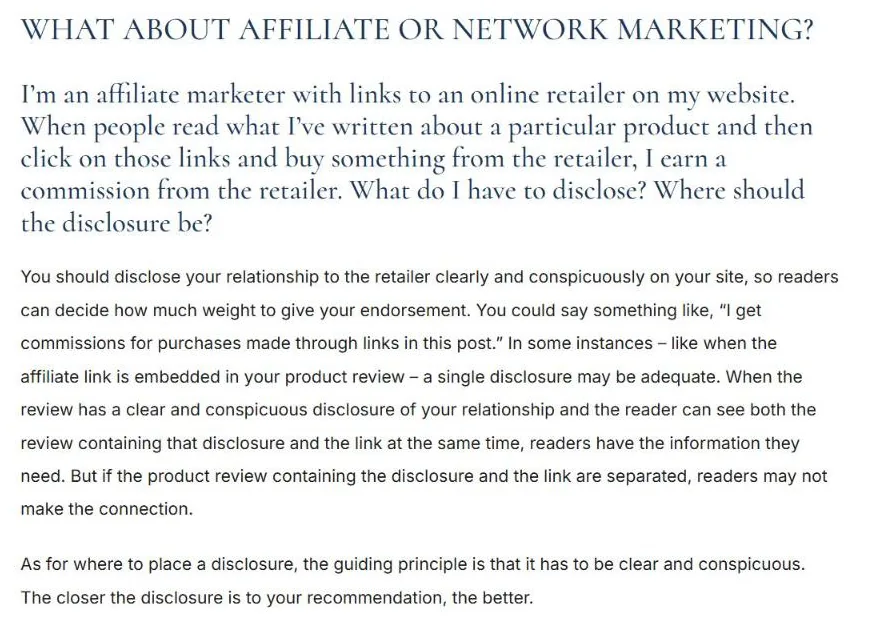
The FTC also warns that consumers might not understand that “affiliate link” by itself means the person is paid for purchases, and that a “buy now” button would not be an adequate disclosure. Programs can add their own rules too: Amazon’s agreement requires associates to state “As an Amazon Associate I earn from qualifying purchases” or a substantially similar statement. If you work across several platforms or countries, review the rules that apply to each one. Etemora explains its own approach on our disclaimer page.
How Can You Build Trust With Affiliate Content?
Trust is the part of what is affiliate marketing that beginners most often underestimate. Be clear about what you know and how you know it. Separate verified product information from your own analysis, identify meaningful limitations and update information when official terms change.
If you have not personally tested a product, do not suggest that you have. Research-based comparisons can still help readers by examining official documentation, pricing, terms and credible independent evidence.
For more ideas about online income, read about practical ways to make money online and explore platforms for finding freelance digital marketing work. If you would rather sell services directly, our guide on how to start freelancing covers the first steps.
How We Compared
This guide to what is affiliate marketing was prepared from official affiliate program documentation (the Amazon Associates program page, FAQ and Operating Agreement), FTC guidance on endorsements and affiliate disclosures, and Google Search Central documentation on qualifying outbound links and spam policies. Sources were checked in October 2026, but program rules and platform policies change. This is a research-based guide; we did not run hands-on tests. Examples are illustrative, so confirm current eligibility, commission rates, tracking rules and payment conditions directly with each program. Read more about how we review products and services.
Final Verdict: What Is Affiliate Marketing?
So, what is affiliate marketing? It is a way to earn potential income by referring an audience to a business through approved tracking links or other referral methods. A commission is earned only when a referral meets the program’s qualifying conditions, and income is never guaranteed.
The strongest starting point is to choose a specific audience, publish genuinely helpful content and recommend relevant products with accurate information. Build a process for checking program terms and maintaining content instead of relying on high commission claims or shortcuts.
- Best fit for bloggers: useful guides and comparisons around questions people search before buying
- Best for video creators: explain products and their limits, following platform and program rules
- Best for beginners with limited resources: one primary content channel and a narrow topic
- Best for website owners: educational content with approved affiliate links where they help readers
- Best for experienced marketers: compare program economics, audience fit, attribution rules and traffic sources
The goal is not simply to add links. It is to help people make better decisions while building a sustainable publishing process.
Want to see a real program’s terms?
Explore the Amazon Associates Program →Frequently Asked Questions
What is affiliate marketing in simple words?
What is affiliate marketing in simple words? It means recommending a business’s product or service and potentially earning a commission when someone makes a qualifying purchase or completes another required action through your referral. You do not usually handle the sale or delivery; your role is to connect the right audience with a relevant offer.
Can beginners make money with affiliate marketing?
Yes, beginners can earn affiliate commissions, but income is not guaranteed. Results depend on audience relevance, content quality, traffic, conversion rates and program terms. It may take time to attract visitors and earn qualifying referrals, and some websites or channels never become profitable.
Do I need a website for affiliate marketing?
Not always. Some programs accept eligible creators using video channels, social media, newsletters or other approved platforms. Amazon, for example, lets participants monetize a website, social media content or app. Each program has its own eligibility rules, so confirm your platform is allowed before applying.
Is affiliate marketing free to start?
It can be started with little upfront spending if you use an existing platform and free content tools. Costs may arise if you buy a domain, pay for hosting, subscribe to software or run advertising. Check the expenses before investing, because commissions and profits are not guaranteed.
How much can you earn from affiliate marketing?
There is no fixed amount. Income varies with traffic, conversion rates, product prices, qualifying actions, commission terms and expenses. A website can receive visitors without generating sales, so treat earnings examples as illustrations rather than predictions.
How do I find affiliate marketing programs?
Start with official company websites and look for pages labelled affiliate program, partner program or publisher program. Affiliate networks can also list multiple merchants. Compare eligibility, commission rules, payment terms, promotional restrictions and product relevance instead of choosing a program only for its advertised rate.
What is an affiliate link?
An affiliate link is a special URL or referral link that helps a program attribute a visitor’s qualifying action to an affiliate. Tracking methods and attribution rules differ by program. A click does not guarantee a commission; the visitor may need to make an eligible purchase or complete another specified action.
Is affiliate marketing legitimate?
People asking what is affiliate marketing often ask this next. Affiliate marketing is a legitimate business model used by many companies and publishers, but individual programs and offers vary. Research the business, read the terms, avoid unsupported income promises and disclose material relationships where required. Be cautious of schemes that demand large upfront payments while promising guaranteed earnings.
Is affiliate marketing the same as dropshipping?
No. Affiliate marketing generally involves referring customers to another business and earning a qualifying commission. In dropshipping, a seller runs a storefront and accepts customer orders while a supplier typically handles fulfilment. Their responsibilities, costs, customer relationships and risks are different.
How long does it take to earn your first affiliate commission?
There is no reliable universal timeline. Your first commission depends on how quickly you publish useful content, attract relevant visitors, gain trust and generate a qualifying referral. Payment can come later still: Amazon, for example, pays about 60 days after the end of the month in which commission was earned.
Sources
- Amazon Associates: program overview and FAQ
- Amazon Associates Program Operating Agreement
- Federal Trade Commission: FTC’s Endorsement Guides: What People Are Asking
- Federal Trade Commission: Disclosures 101 for Social Media Influencers
- Google Search Central: Qualify your outbound links to Google
- Google Search Central: Spam policies for Google web search
- CJ: affiliate and partnership marketing platform
Related articles you may like
 Make Money OnlineSide Hustles That Pay Daily: 10 Legit Ways to Get Paid Fast
 FreelancingFiverr Review for Freelancers (2026): Fees, Levels and Payouts
 Make Money OnlineRemote Jobs With No Experience: 10 Real Options for 2026
 Make Money OnlineRemote Jobs for College Students: 12 Ideas, Tips and Scam Checks
 FreelancingWhat Is Freelancing? Complete Beginner’s Guide 2026
 FreelancingBest Freelance Websites for Developers: 6 Proven Picks