
.com vs .net vs .io vs .co: Best 2026 Domain Extension Choice
 By M. Zaid
- Updated October 9, 2026
- 16 min read
.com vs .net vs .io vs .co is a common choice when the domain name you want is available under several extensions, or when the .com version is already taken. The extension affects branding, what people expect, availability and your long-term domain costs, but it does not automatically decide your Google rankings.
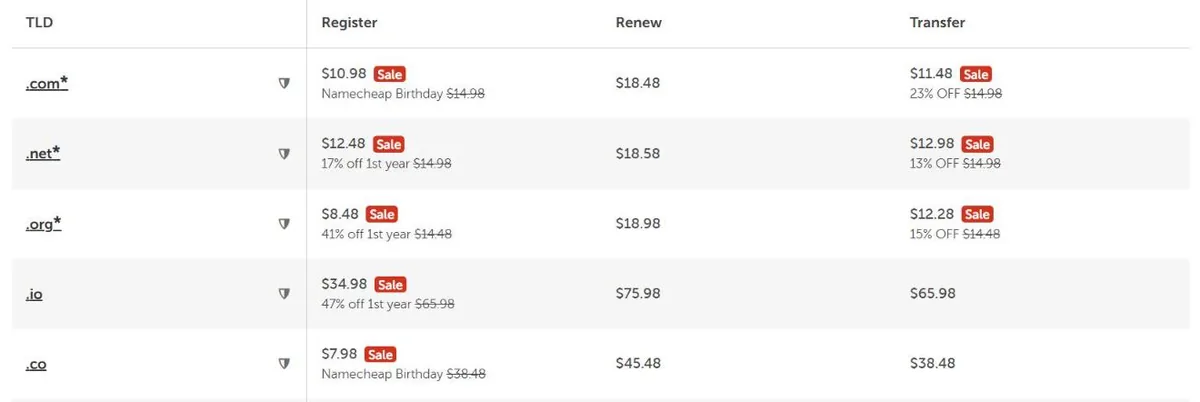
This comparison explains what each extension means, how Google treats it, what it costs to register and renew, where each one fits, and what to check before you buy. Prices are Namecheap’s published US-dollar prices, checked in October 2026.
Quick answer: For most businesses and broad audiences, .com is still the safest choice because it is familiar and general-purpose. Choose .net for technology or networking projects, .io for software and developer brands that can afford its $75.98/year renewal, and .co for short startup names when the .com is taken. Google does not give any of the four a ranking boost just for the extension.
Check which extensions are free for your name
Check Current Domain Pricing →.com vs .net vs .io vs .co at a Glance
| Extension | Best for | Regular price (1st year) | Renewal | Key strength | Main drawback |
|---|---|---|---|---|---|
| .com | Businesses, creators, broad brands | $14.98 | $18.48/yr | Familiar, general-purpose | Short names are mostly taken |
| .net | Technology, networks, online services | $14.98 | $18.58/yr | Long-established tech association | Less familiar than .com |
| .io | Startups, software, developer tools | $65.98 | $75.98/yr | Strong tech/startup association | Much higher renewal cost |
| .co | Startups, agencies, short brands | $38.48 | $45.48/yr | Short and brand-friendly | Renewal 2.5x the .com price |
Namecheap’s regular (non-sale) US prices, checked October 2026, before tax. We use regular prices because promotions come and go; at the time of checking, Namecheap was running temporary first-year discounts on all four. Namecheap adds a $0.20 ICANN fee to some domains, including .com and .net, and premium names cost more.
What Do .com, .net, .io and .co Actually Mean?
To compare .com vs .net vs .io vs .co properly, start with the basics. A domain extension is the top-level domain (TLD) at the end of a web address. In ICANN’s definition, .com and .net are generic top-level domains (gTLDs), the general-purpose class that also includes .org and .edu. In the IANA root zone database, .io and .co are technically country-code TLDs: .io for the British Indian Ocean Territory and .co for Colombia.

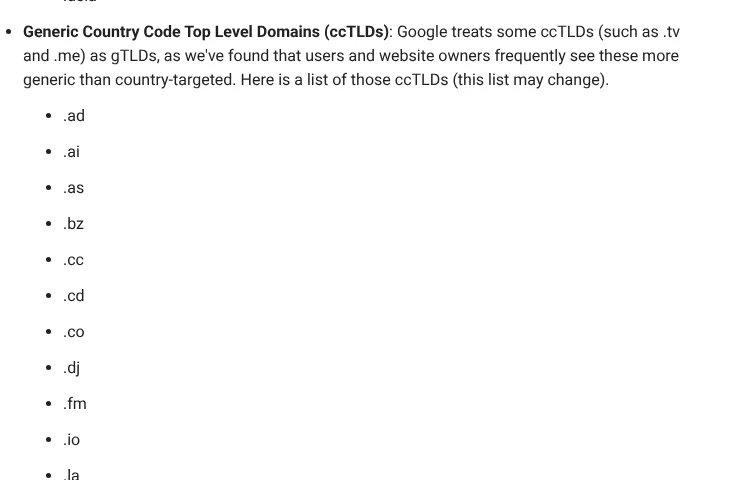
That technical label can be confusing, because Google does not treat .io or .co as country-targeting signals. Its guide to managing multi-regional sites lists both among the ccTLDs it treats like gTLDs, because users and site owners see them as generic.
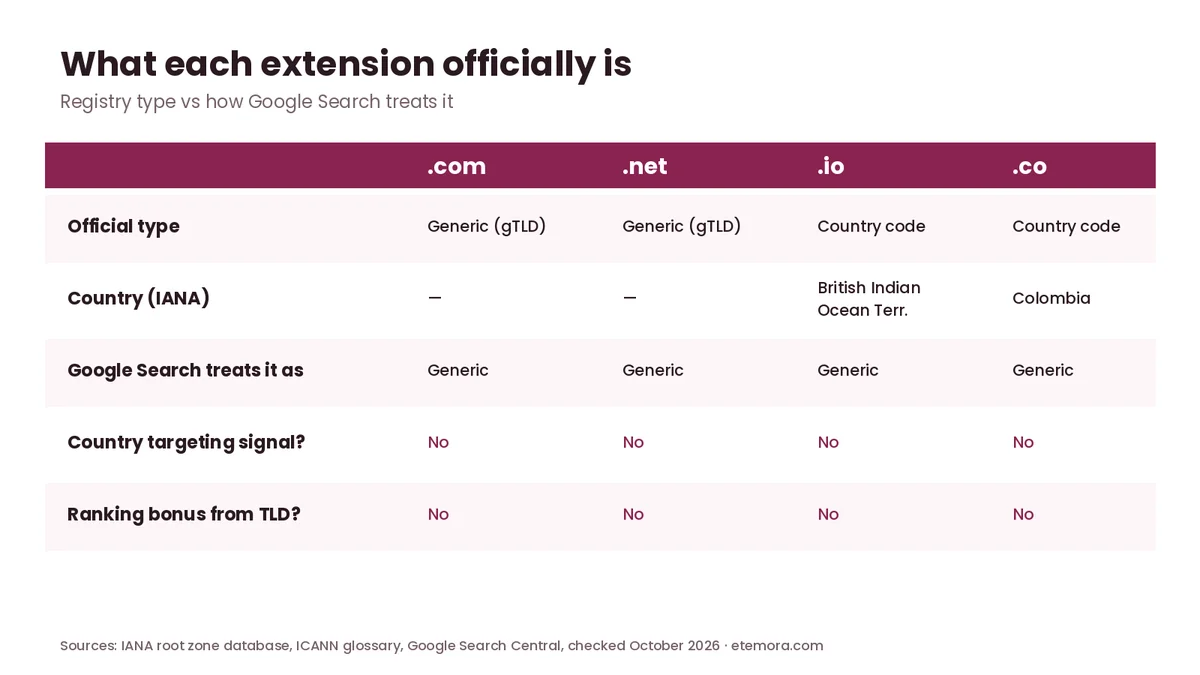
So the practical question in .com vs .net vs .io vs .co is not which extension is “more powerful”. It is which one fits your audience, brand, budget and expectations.
.com: Best for Most General-Purpose Businesses
.com is the default choice for most commercial websites, brands, creators and online businesses. It is a generic TLD rather than a country extension, so it works naturally for an international audience. Namecheap’s .com page calls it “the world’s most popular domain”.
For a business whose domain will be spoken aloud, .com has another practical advantage: many people already expect a business website to end in .com. That does not make other extensions invalid, but it makes .com easier to communicate.
Namecheap’s regular .com price is $14.98 for the first year and $18.48 to renew. Temporary promotions often lower the first year (it showed a sale price when we checked), but the renewal is what you pay long term.
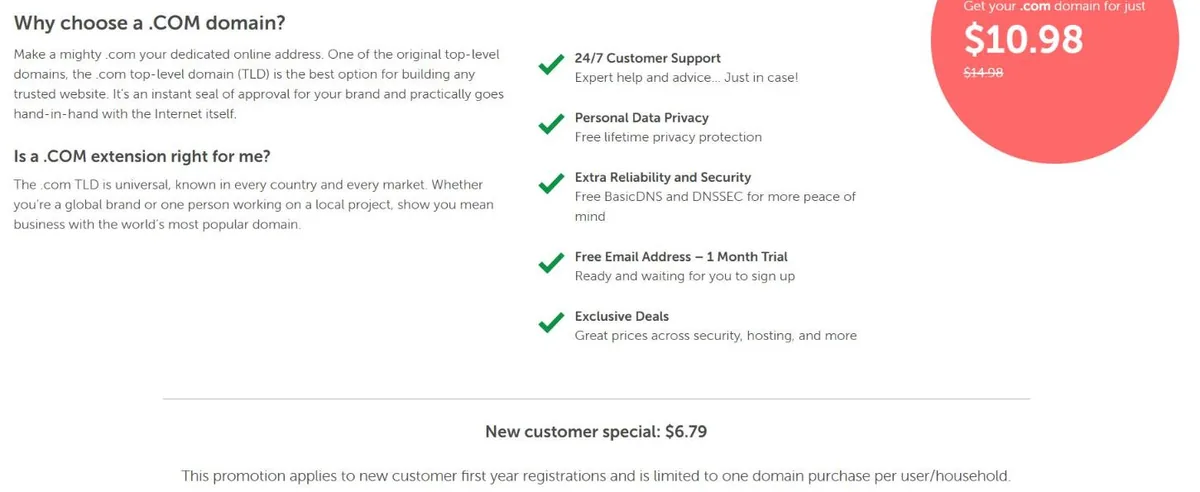
Why choose .com?
- Broad business and brand positioning
- Easy to understand for a general audience
- Suitable for international websites
- No industry restriction
- Strong familiarity among internet users
Downsides of .com
The biggest problem is availability: many short, dictionary-word and desirable brand names are already registered. A good .com can also cost far more on the aftermarket if someone else owns it, which is separate from the normal registration price.
SEO considerations for .com
There is no automatic Google ranking bonus for using .com. Google’s own answer is that its goal is “to return the best and most relevant results to people, regardless of the top-level domain”. A well-built .net, .io or .co site can rank just as well, so the extension is no substitute for useful content, links and a clear site structure.
Skip .com if the exact name is unavailable at a sensible price, or if another extension gives you a clearly better, more memorable name.
Is your .com still available?
Check .com Pricing →.net: Best for Technology and Network-Focused Projects
.net was originally intended for networks and internet service providers, and today anyone can register one. Namecheap’s .net page describes it as one of the oldest TLDs and “the second most popular TLD after .com”, and suggests it as a trustworthy alternative when your .com is taken.

Namecheap’s regular .net price is $14.98 for the first year and $18.58 to renew, only 10 cents more than .com.
Why choose .net?
- Long-established extension
- Natural fit for networking, hosting and technology services
- Open for general registration
- Usually easier to find than an equivalent short .com
- Renewal price almost identical to .com
Downsides of .net
.net can create a different expectation from .com, and a consumer brand may find it less immediate. There is also a memory risk: if another company owns the .com, people who hear your .net address may type the .com by mistake. That is a branding issue, not a technical weakness.
Is .net good for SEO?
Yes. Google has no rule that makes .net rank below .com. If a .net gives you a clean, memorable brand while the available .com is awkward, .net is a reasonable choice.
Skip .net if your business depends on a broad consumer brand and the matching .com is available at a reasonable price.
Considering .net for a tech project?
Check .net Pricing →.io: Best for Technology Startups and Software Brands
.io is strongly associated with technology, software, developer products and startups, partly because “I/O” means input/output in computing. Technically, the IANA .io record lists it as the country-code TLD of the British Indian Ocean Territory, but Google treats it as generic for search.

Namecheap’s regular .io price is $65.98 for the first year and $75.98 to renew, roughly four times the .com renewal.
Why choose .io?
- Strong association with technology
- Short and visually clean
- Works well with software-style brand names
- Useful when the matching .com is unavailable
- Not treated as a country-targeting TLD by Google
Downsides of .io
Cost is the clearest issue. At $75.98 a year, renewal is more than four times the .com renewal at Namecheap, and those yearly payments add up if you keep the domain for many years.
Is .io good for SEO?
The extension gives no automatic advantage or disadvantage. The better question is whether your audience understands the brand and types the domain correctly.
Skip .io if you run a general consumer business with a suitable .com available, or if the renewal cost doesn’t fit your budget.
Building a software or developer brand?
Check .io Pricing →.co: Best for Startups and Short Brand Names
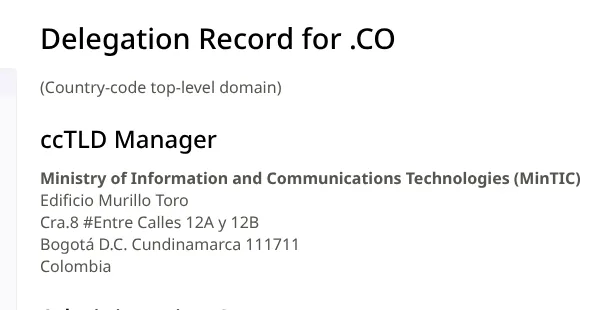
.co is technically Colombia’s country-code TLD. The IANA .co record names Colombia’s Ministry of Information and Communications Technologies (MinTIC) as the ccTLD manager. Namecheap notes that .co was originally assigned to Colombia but that anyone has been able to register one since 2010, and Google treats it as generic rather than a Colombia signal.
.co is popular for short company names because “co” reads naturally as “company”. Namecheap’s regular .co price is $38.48 for the first year and $45.48 to renew, about 2.5 times the .com renewal.
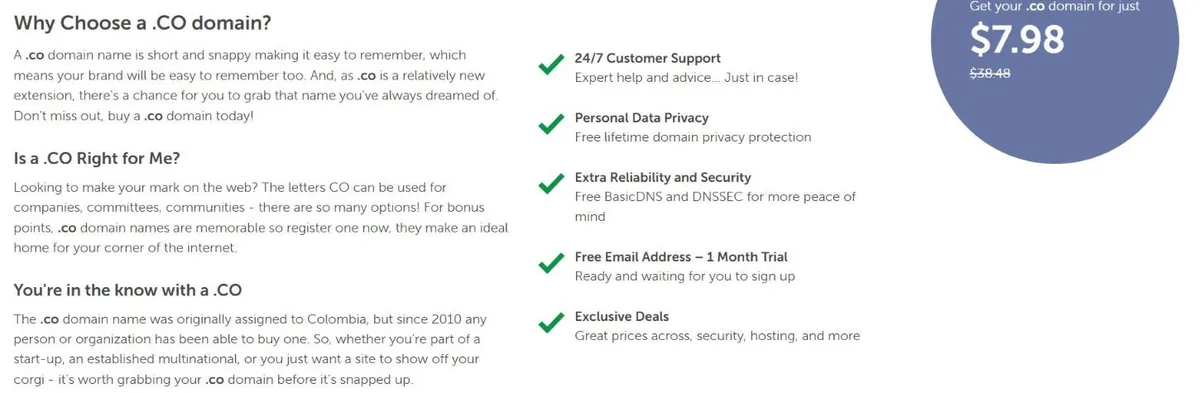
Why choose .co?
- Short and visually simple
- Strong fit for startup-style branding
- Can work when a desirable .com is unavailable
- Broad enough for many business categories
- Treated as generic by Google
Downsides of .co
Cost is higher than it first looks: promotional first-year deals on .co can be very cheap, but every renewal is $45.48. There is also the same branding risk as .net: some people will type .com after hearing your name, so check whether the matching .com belongs to an active business before committing.
Is .co good for SEO?
Yes. Because Google treats .co as generic, it does not limit your site to Colombia or create a general ranking disadvantage.
Skip .co if the matching .com belongs to a competitor, or the renewal price makes it unattractive over several years.
Have a short startup name in mind?
Check .co Pricing →.com vs .net vs .io vs .co: Pricing Over Time
Looking only at a first-year promotion can lead to the wrong decision. In this .com vs .net vs .io vs .co comparison, we use Namecheap’s regular prices because they stay stable while sales come and go. .io has the highest recurring cost at $75.98 a year and .co renews at $45.48. By comparison, .com and .net renew at $18.48 and $18.58.
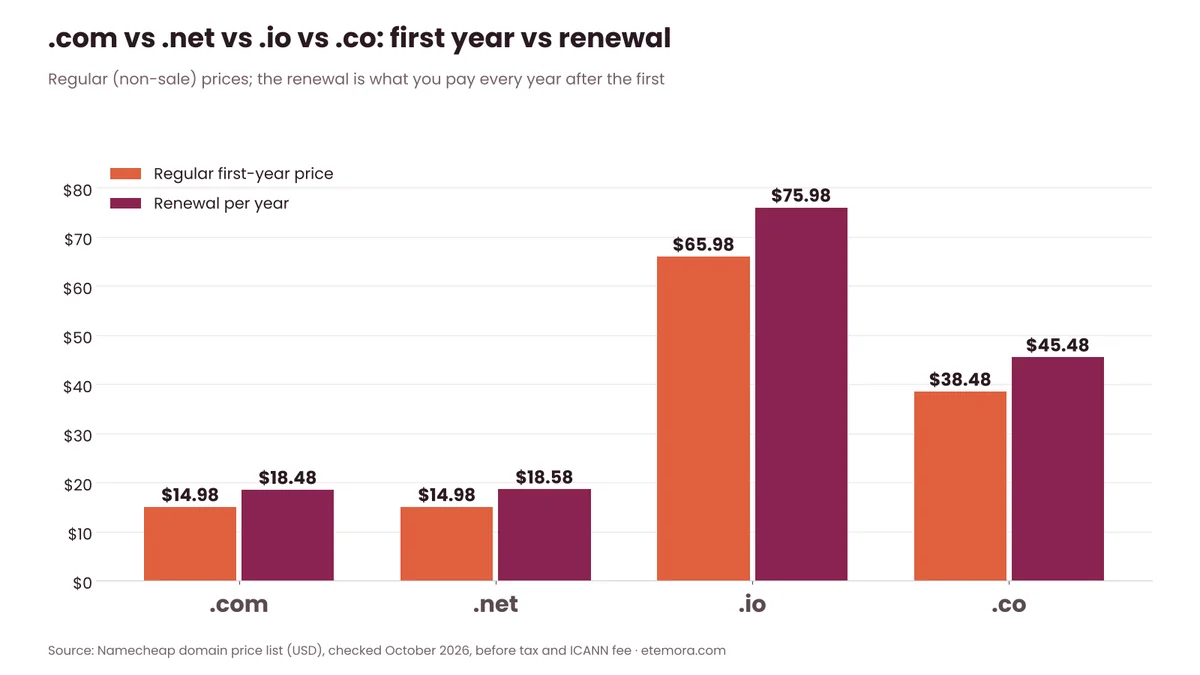
| Extension | Regular 1st year | Renewal | Renewal vs .com | 5-year cost* |
|---|---|---|---|---|
| .com | $14.98 | $18.48 | 1.0x | $88.90 |
| .net | $14.98 | $18.58 | 1.0x | $89.30 |
| .io | $65.98 | $75.98 | 4.1x | $369.90 |
| .co | $38.48 | $45.48 | 2.5x | $220.40 |
*Our calculation: one registration at the regular price plus four renewals, before tax and any ICANN fee. A first-year promotion lowers the total slightly; renewals are unaffected.
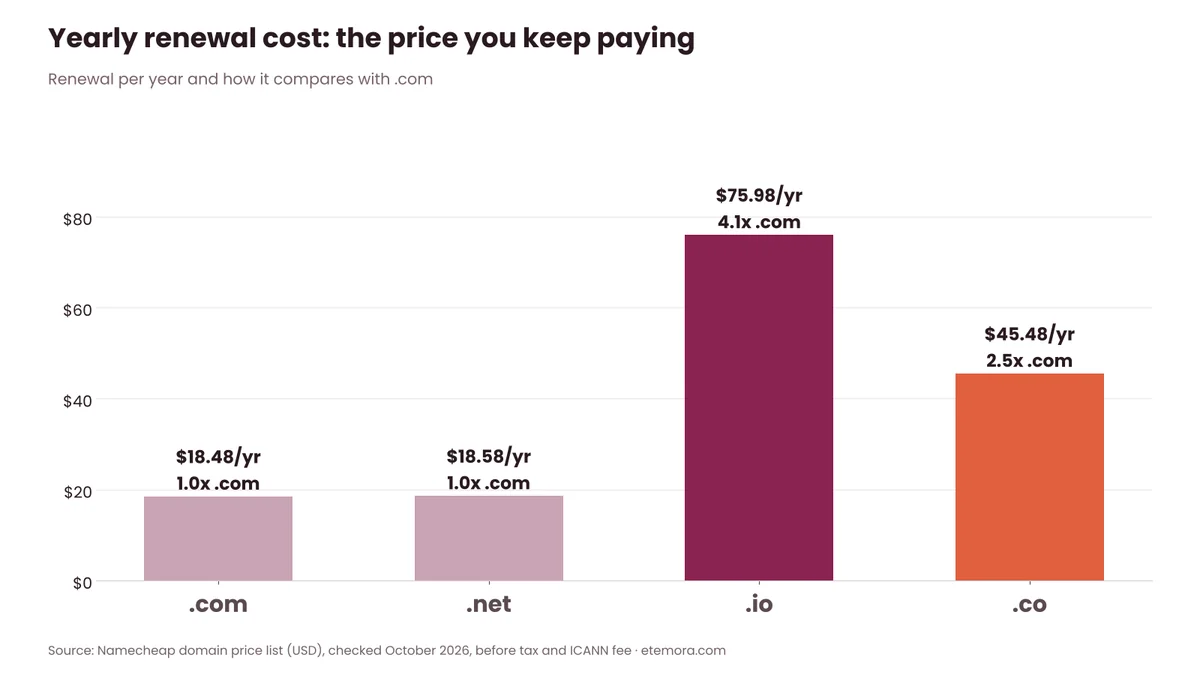
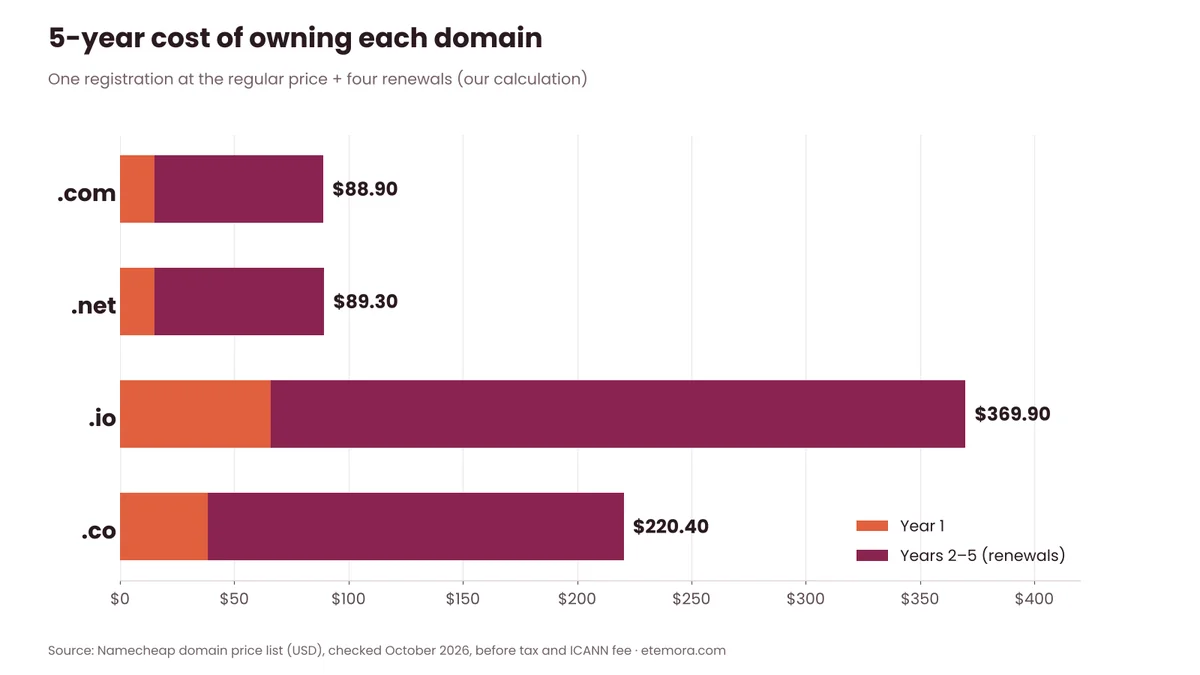
This is why renewal pricing matters more than the promotion. Our guide to domain renewal price increases explains how to keep these costs down, and our domain renewal cost calculator lets you run your own numbers.
Compare renewal prices before you register
See Namecheap’s Full Price List →Does the Domain Extension Affect SEO?
For most websites weighing .com vs .net vs .io vs .co, not in the way many people assume. Google’s site position FAQ answers the question “Does my top-level domain impact my site’s performance in Google Search?” with a plain “No”.

So choosing .com only because you expect a direct ranking boost is not a strong reason. The more meaningful factors are the quality and relevance of your content, technical accessibility, links and overall usefulness.
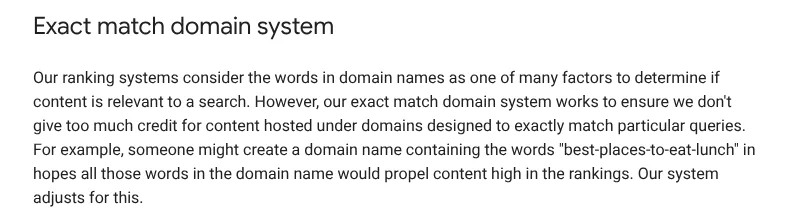
Keywords in the domain don’t carry much weight either. Google’s ranking systems guide says words in domain names are “one of many factors”, and its exact match domain system makes sure sites don’t get too much credit just because the domain matches a query.
Does .io rank better for technology websites?
There is no Google rule saying it does. A .io can be an excellent branding choice for software audiences, but that association is not a ranking advantage.
Does .co rank as a Colombian website?
Not necessarily. Google lists .co among the ccTLDs it treats as generic, which is different from how it treats country domains such as .uk or .de.
Brand Trust: Does .com Still Matter?
This is where .com vs .net vs .io vs .co matters more than SEO. Your extension appears in search results, ads, emails, social profiles, invoices and conversations, and a familiar extension needs less explanation.
That doesn’t mean people distrust .net, .io or .co. It means the extension is part of the overall brand impression:
- For a broad consumer business, .com is usually the least complicated choice.
- For a developer tool, .io may signal the product category quickly.
- For a startup with a short name, .co can work well if the rest of the branding is clear.
- For a network-oriented company, .net can feel natural.
Domain Availability: Should You Change the Brand to Get .com?
Not always, and this is where .com vs .net vs .io vs .co gets practical. If your preferred name is available as a short .io but the .com needs extra words, hyphens or numbers, the .io may be the cleaner brand. The reverse is also true: if the .com is available at a fair price for a consumer business, it simplifies everything.
Compare the complete domain, not just the extension:
- short-brand.com
- short-brand.net
- short-brand.io
- short-brand.co
A clean .net can beat an awkward .com, and a clean .com can beat a .co that is easily confused with another company. Before you register, search all four versions and check whether another active business uses a similar name. Our guide to the best domain registrars covers where to buy, and you can compare domain registrars side by side when prices differ.
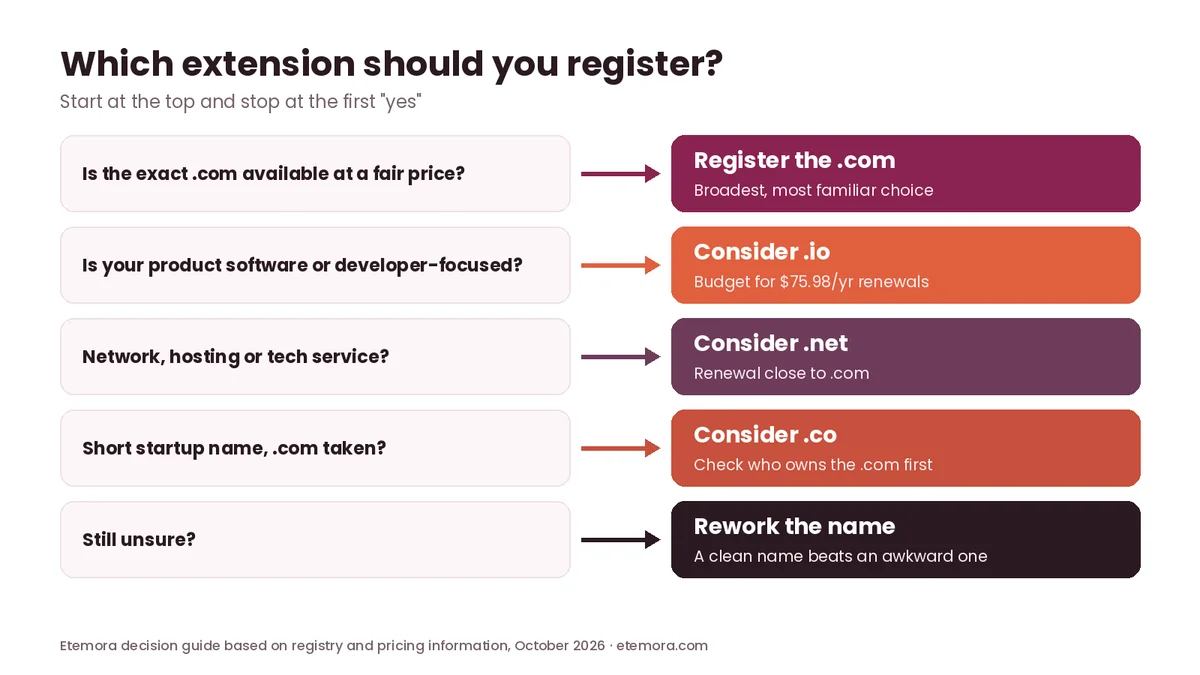
How to Choose Between .com, .net, .io and .co
1. Start with your audience
A consumer brand has different needs from a developer tool or networking service. If your domain will be heard on podcasts, videos or sales calls, pick something easy to say and spell.
2. Check the .com first
If the exact .com is available at a sensible price and fits your brand, take it seriously. Not because Google ranks it higher, but because it gives you a broad, familiar identity.
3. Look at renewal pricing
Never judge a domain by its first-year promotion. The renewal is the permanent cost: $18.48 for .com, $18.58 for .net, $45.48 for .co and $75.98 for .io at Namecheap.
4. Check competing domains
If your .co, .io or .net is very close to an established .com brand, reconsider the name. The risk is human confusion, not Google’s algorithm.
5. Think about brand positioning
- General business: .com
- Technology or networking: .net
- Software or developer startup: .io
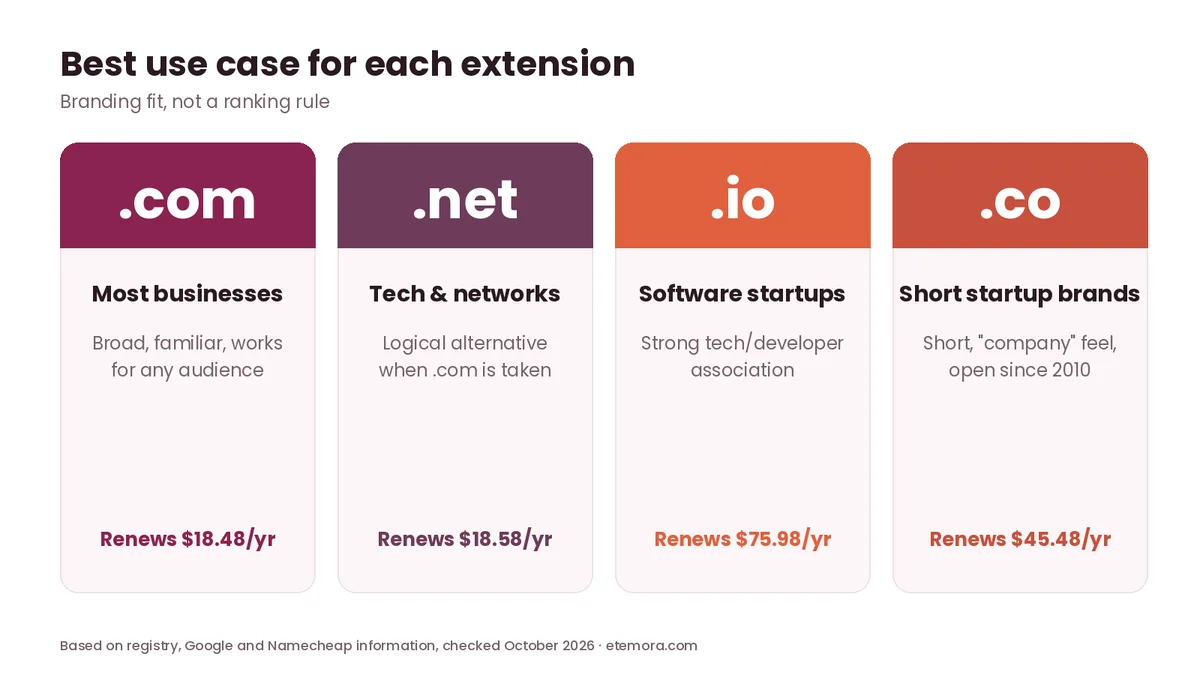
- Short startup brand: .co
These are positioning suggestions, not SEO rules.
6. Consider long-term ownership
A domain can stay part of your identity for many years. Over five years at regular prices, our calculation puts .io at $369.90 and .co at $220.40, against $88.90 for .com.
7. Register defensively when it makes sense
Once a brand becomes valuable, owning more than one extension can reduce confusion, for example using the .com as your main site and redirecting the .co. It adds recurring costs, so weigh it against your real risk. If you are new to buying domains, start with our guide on how to buy a domain name.
How We Compared
This .com vs .net vs .io vs .co comparison is research-based; we did not run hands-on tests. We used IANA’s root zone records, ICANN’s terminology, Google Search Central documentation and Namecheap’s published US-dollar pricing, all checked in October 2026, with first-year and renewal prices treated separately. See how we review for our wider methodology.
Final Verdict: .com vs .net vs .io vs .co
The best choice in .com vs .net vs .io vs .co depends more on your brand and audience than on SEO, because Google doesn’t favour any of these extensions for the extension alone.
- Best for most businesses: .com. The broadest, most familiar identity when the name is available at a sensible cost.
- Best for networking and technology services: .net. A natural fit with renewals almost identical to .com.
- Best for software and developer startups: .io. Strong tech association, if you accept the $75.98/year renewal.
- Best for short startup brands: .co. Short and memorable, but plan for the $45.48/year renewal.
Ready to register your domain?
Check Current Domain Pricing →Frequently Asked Questions
Is .com better than .net?
For most broad consumer and business brands, .com is the simpler choice because it is more familiar. But Google gives .com no automatic ranking advantage over .net, so a strong, memorable .net is sensible when the .com is unavailable.
Is .io better than .com for SEO?
No. Google treats .io as generic and gives it no general ranking advantage. Its main value is branding for technology and software businesses.
Is .co a good domain extension?
Yes, especially for startups and short brand names. Google treats .co as generic rather than as a Colombia-targeted domain. The main things to check are the renewal price ($45.48/year at Namecheap) and possible confusion with the matching .com.
Is .io a country-code domain?
Technically, yes. IANA lists .io as the country-code TLD of the British Indian Ocean Territory. Google, however, treats it as generic for search, so it is not a country-targeting signal.
Is .co a country-code domain?
Yes. IANA lists .co as Colombia’s country-code TLD, managed by MinTIC. Google treats it as generic, so a .co site is not automatically targeted to Colombia in Google Search.
Which domain extension is best for a startup?
It depends on the brand. .com is the broadest option, .io signals technology and .co suits short company names. Compare renewal prices before deciding, because first-year promotions can be far lower than what you pay later.
Does .net rank lower than .com?
No. Google says the top-level domain does not affect a site’s performance in Search. The difference is about user expectations, not ranking signals.
Why is .io more expensive?
Retail prices depend on registry and registrar pricing. At Namecheap in October 2026, .io’s regular price is $65.98 for the first year and $75.98 to renew, far more than .com ($18.48) or .net ($18.58) renewals.
Should I buy both .com and .co?
It can make sense when the brand matters and the extra yearly cost is justified, for example using .com as the main site and holding the .co to prevent confusion. It isn’t necessary for every website.
Should I buy .com if the domain name is expensive?
Not automatically. If the matching .com is an expensive aftermarket purchase, compare its value with a clean .net, .io or .co. A memorable name under another extension is often more practical for a new business.
Related articles you may like
 DomainsWhat Is a Domain Name? A Simple Guide for 2026
 DomainsCheapest Domain Registrars: 6 Best Deals in 2026
 DomainsChoose a Domain Name: 10 Proven Tips for 2026
 Domains.com Renewal Prices 2026: What 9 Registrars Charge Above Wholesale
 DomainsNamecheap Review: Honest 2026 Pricing & Features
 DomainsNamecheap vs GoDaddy: 2026 Honest Domain Comparison