Our approach to reviews, comparisons and recommendations — what we examine, where our information comes from, and the difference between research-based evaluation and hands-on testing.
Last Updated: September 2026At Etemora, we believe that a useful review should do more than tell you whether something is “good” or “bad.”
It should help you understand what a product or service offers, what it costs, where it performs well, where its limitations are, who it is suitable for, and how it compares with alternatives.
Our reviews and comparisons are designed to give readers the information they need to make more informed decisions.
Because Etemora covers different types of products and services, our exact evaluation process can vary by category. However, we follow a consistent set of editorial principles across our content.
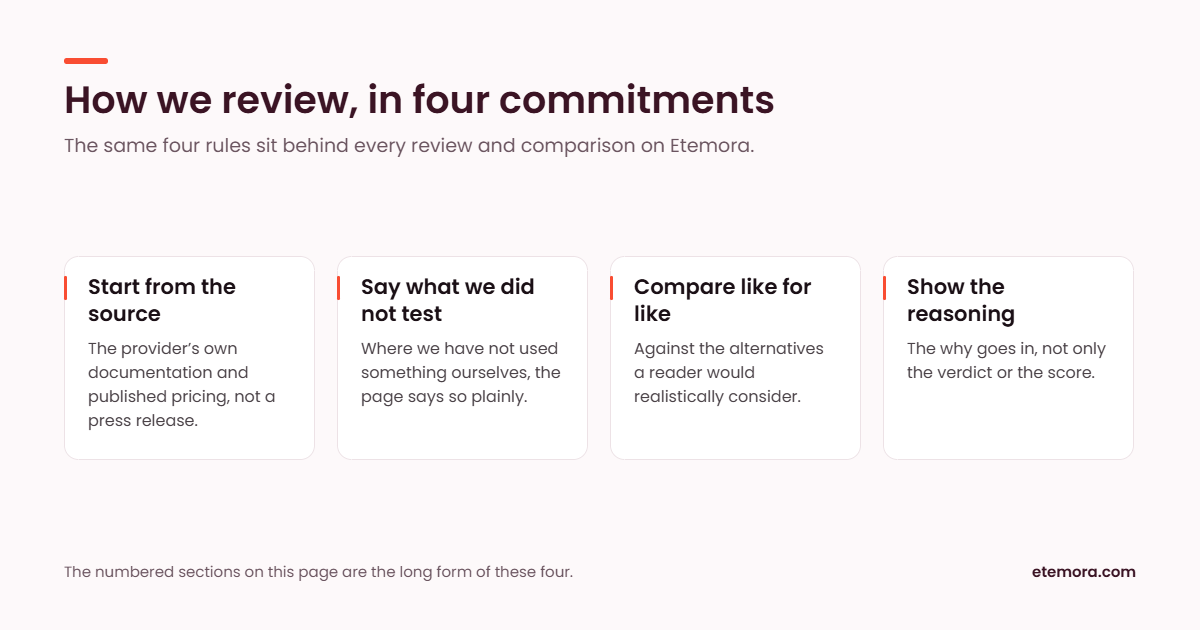
How we review, in short. It comes down to four commitments: we start from the product’s own documentation and published pricing, we say plainly when we have not tested something ourselves, we compare against the alternatives a reader would realistically consider, and we publish the reasoning rather than only the verdict. The sections below are the long form of how we review, one step at a time.
If something we have published does not match how we review as set out here, treat it as a mistake on our part and tell us — there is a correction route near the end of this page. How we review will also change as categories change; when it does, this page is updated first, so that how we review is never behind what we publish.
Questions about how we review are welcome. If a comparison looks wrong, or a figure is out of date, the fastest fix is to tell us which page and which number. That feedback is part of how we review, not separate from it.
Before reaching a recommendation, we first try to understand what the product or service actually offers.
Depending on the category, we may examine:
We focus on the factors that are most relevant to the purchasing decision. A feature that matters greatly for a professional user may not matter as much to a beginner.
That’s why our evaluations consider who the product is actually for.
Many Etemora reviews are research-based rather than laboratory-tested or independently benchmarked.
Our research can include information from:
We compare information from multiple sources where appropriate rather than relying solely on marketing descriptions.
If we did not personally test something, we don’t say that we did.
Some Etemora content is based primarily on research and publicly available information.
That means we do not automatically claim:
… unless that work was actually performed.
When an article contains information reported by a company, we may identify it as company-provided information rather than presenting it as an independent Etemora test result.
We believe being transparent about the limits of our research is more useful than creating an impression of experience that we don’t have.
We examine the features that are relevant to the product’s intended purpose.
Depending on the category, this may include:
We also look at whether important features are included in the advertised plan or require a higher-priced plan.
A long feature list does not automatically make a product better. What matters is whether the features are useful for the intended user.
Price is an important part of almost every buying decision.
We look at:
We also compare pricing against relevant alternatives.
Products and services can change their prices, plans, discounts, and renewal rates.
Pricing information on Etemora should be treated as a snapshot of the information available when the content was researched or updated. Always check the provider’s current pricing page before purchasing.
A product can have excellent features and still be difficult for its intended audience.
Where relevant, we consider:
We consider ease of use in context. A professional product may intentionally offer more advanced controls, while a beginner-focused product may prioritize simplicity.
Neither approach is automatically better.
Performance can mean different things depending on the category. For example, it may refer to:
Where reliable information is available, we consider documented performance-related information. However:
We do not present company-reported figures or third-party benchmarks as measurements performed by Etemora.
If we have not independently tested a performance metric, we do not claim that we measured it ourselves.
For products and services where security or reliability matters, we consider relevant information such as:
Where specific security or reliability claims come from a provider, we treat them as provider information unless independently verified.
Security is also highly dependent on configuration and user behavior.
Customer support can be an important part of a product’s overall value.
Where relevant, we examine publicly available information about:
The availability and quality of support can change over time. We therefore avoid presenting support information as permanently guaranteed.
We believe products should rarely be evaluated in isolation.
When creating a comparison, we look at relevant alternatives and ask:
This helps us move beyond simply listing features.
A product can be excellent without being the best option for every reader.
One of the most important parts of our evaluation is identifying the type of user who may benefit from a product.
Depending on the topic, we may evaluate whether an option is suitable for:
Our recommendations are therefore often expressed in terms of best for a particular use case, rather than claiming that one product is universally the best.
A useful review should discuss both advantages and limitations. We may identify:
Features, pricing, capabilities, usability, or other factors that make an option attractive.
Limitations, higher costs, missing features, restrictions, complexity, or other factors that may matter to certain users.
We don’t believe a review becomes more trustworthy simply by being positive or negative. The goal is to explain why we reached an assessment.
Our final recommendation considers the overall picture. We may weigh:
There is no single formula that applies to every category. For example:
Context matters.
Sometimes our research leads to a negative or mixed assessment. When that happens, we focus on specific and supportable issues.
“This company is terrible.”
“This plan costs more than several competing options while offering fewer features at the entry level.”
The second statement gives the reader something they can actually evaluate.
Our reviews focus on products, services, features, pricing, policies, limitations, and documented information. We avoid unsupported claims about a company’s motives, intentions, honesty, or character.
Companies naturally present their products in a positive way. That information can still be useful, but we distinguish between:
A provider advertises a particular feature. We may report that the provider offers or advertises that feature.
We do not automatically convert that claim into “Etemora independently verified this feature” — unless we actually did so.
This distinction helps readers understand the basis of our conclusions.
Some links on Etemora may be affiliate links.
If you purchase something through a qualifying affiliate link, Etemora may receive a commission at no additional cost to you. Affiliate relationships help support the website. For background on affiliate disclosure standards, see the FTC endorsement guidelines.
However, affiliate compensation does not automatically determine our editorial conclusion. We may recommend, criticize, or choose not to recommend a product regardless of whether an affiliate relationship exists.
Our objective is to provide useful information and help readers compare their options. Full details are in our Affiliate Disclosure.
Affiliate commissions can differ significantly between products and services.
A product offering a higher commission is not automatically a better product.
Our evaluation should consider factors such as:
The goal is to avoid making commission level the primary reason for a recommendation.
Products and services change. We may update content when meaningful changes occur, including changes to:
However, we cannot guarantee that every change will be reflected immediately. If you notice outdated information, please contact us.
We welcome legitimate corrections.
If you believe that an Etemora article contains an incorrect factual statement, please contact us with:
We will review the information. If the evidence supports a correction, we may update, clarify, or correct the content.
A correction request does not guarantee that we will change an editorial conclusion or opinion.
Every Etemora review and comparison should follow these principles:
We aim to use reliable and relevant information.
We clearly communicate how information was obtained and whether affiliate relationships exist.
We consider both advantages and limitations.
We consider who a product is actually suitable for.
Commercial relationships should not automatically determine editorial conclusions.
We do not claim testing or experience that we did not actually perform.
The purpose of a review is to help the reader make a better-informed decision.
Etemora does not intentionally:
Etemora is growing, and our editorial process may evolve over time.
As we gain access to additional testing capabilities, data, tools, products, and resources, some categories may incorporate more direct testing or original research.
When that happens, we will distinguish those methods from research-based evaluations rather than applying the same label to everything.
Our goal is to make the basis of each evaluation as clear as reasonably possible.
Where hands-on testing or original testing has actually been performed, the relevant article should clearly state what was tested and how.
The purpose of Etemora is not simply to tell you: “Buy this.”
Our goal is to help you understand:
That’s what we believe makes a review genuinely useful.
If you have a question about how we review, believe an article contains outdated information, or have evidence that a factual statement should be corrected, we’d like to hear from you.
Contact EtemoraWe will continue working to make Etemora’s reviews and comparisons:
Clear. Transparent. Research-based. Useful.
We may not always tell you which product is “the best.” Instead, we aim to explain which option may be best for a particular need — and why.
Research smarter. Compare better. Choose with confidence.
© 2026 Etemora. All rights reserved.
See also: About Etemora, Disclaimer, Privacy Policy and Terms of Service.
